In September of 1966, Jewish activists disrupted Yom Kippur services outside of the Washington Hebrew Congregation in Washington, D.C., kickstarting a long and acrimonious battle between Jewish radicals and members of the larger community. The group of young professionals, which formally organized as “Jews for Urban Justice,” distributed leaflets decrying the congregation’s rabbi, Norman Gerstenfeld, for “abandoning the principles of Judaism.” Gerstenfeld, a Reform leader, had rejected calls to condemn prominent congregant Allie Freed, a wealthy landlord said to discriminate against Black Americans. Remarking on the significance of Yom Kippur, the Day of Atonement, the activists noted that it was “a day for inward scrutiny,” when Jews across the world would atone “for their sins and transgressions.” Keeping in spirit with the holiday, members of Jews for Urban Justice vowed to change the practices of Jewish leadership in D.C., demanding accountability, moral clarity, and redemption from complicity in racism.
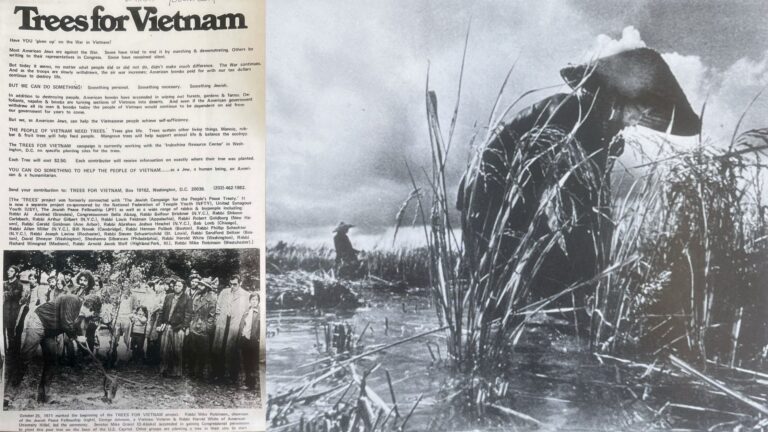
The activities of Jews for Urban Justice provide insight into how radical Jews fused religious conventions with their political causes. In contrast to secular Jews involved in the mainstream counterculture, Jews for Urban Justice framed their social critiques through Judaism’s teachings. Yom Kippur – an occasion on which Jews seek forgiveness from God – inspired these radicals to repurpose Jewish traditions to confront the many issues plaguing 1960s America, from racial inequities to the Vietnam War. Members argued that the community’s “inaction” in response to injustice, whether in the form of racist housing policies or a destructive war, constituted a betrayal of “Judaic principles” that emphasized humanity and equality.
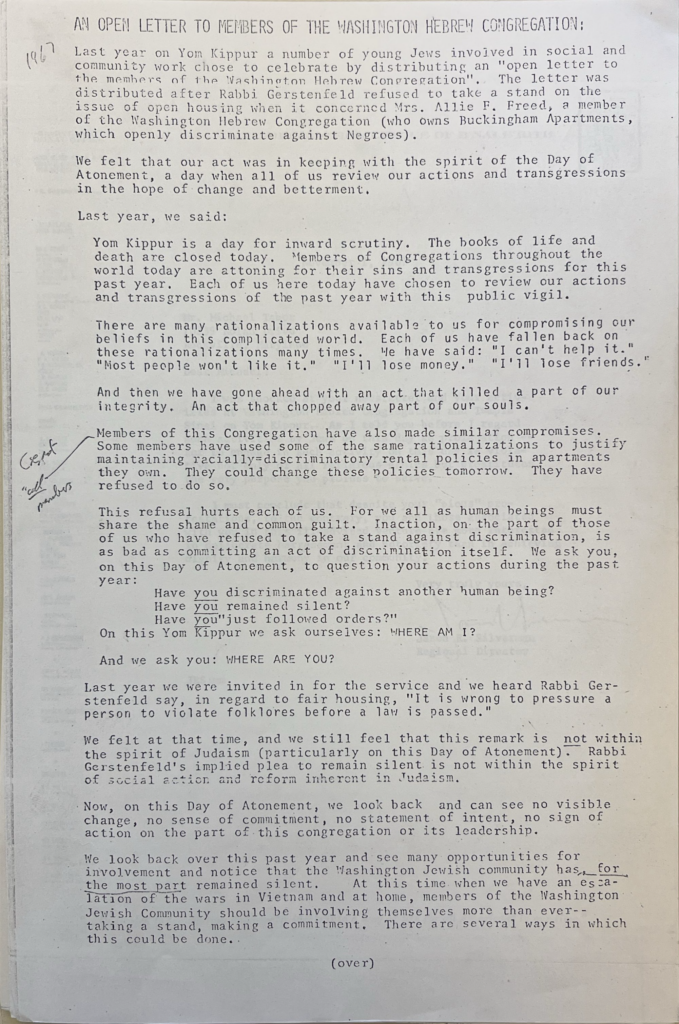
The initial demonstration failed to bring about the changes Jews for Urban Justice envisioned. In 1967, the group repeated their Yom Kippur protest and drafted an open letter to members of the Washington Hebrew Congregation. The message implored Jews to look inward and ask themselves, “have you discriminated against another human being? Have you remained silent? Have you ‘just followed orders’?”—pointedly borrowing a phrase that recalled the rationalizations of former Nazis. Some Jewish community figures in Washington chastised the activists for “playing God,” disagreeing with their tactics of disturbing a holy day with protests.
Jason Silverman, Regional Director of the Anti-Defamation League in the D.C. area, chastised the group in a searing letter. “I regard such activities by Jews on this day as profanation,” he wrote, “for to engage in such activity on this day is violative not only of all religious ethics but prostitutes the very purpose you profess to serve.” Many Jews echoing Silverman’s sentiments shared the political beliefs of the radicals but resented their combative approach. One journalist expressed concern that “the washing of dirty linen in public” would bring about negative attention to Jews, and that while “the Jewish community might well strive for a better record,” Jews were not “nearly as remiss as the whole of the white community” when it came to racial discrimination. Jews for Urban Justice organizer Michael Tabor fervently disagreed with the critics. “We don’t really think that Yom Kippur or any other holy day is inappropriate for protest and discussion,” he retorted.
In the years that followed, Tabor and his fellow activists continuously clashed with D.C.’s Jewish leadership. Their disputes came at a tumultuous time in American Jewish life, when many worried that rapid assimilation among younger Jews could mean the dilution of their Jewish identities. In 1968, Jews for Urban Justice theorized that “many of our Jewish brothers and sisters” were “dropping out of Jewish life because they, too, are appalled by the lack of concern for social justice.” A year later, D.C.’s Tifereth Israel Congregation agreed to help soothe the tensions that had divided the local Jewish community. Its leaders would allow Rabbi Arthur Waskow, a Jewish radical associated with Jews for Urban Justice, to speak on Yom Kippur.
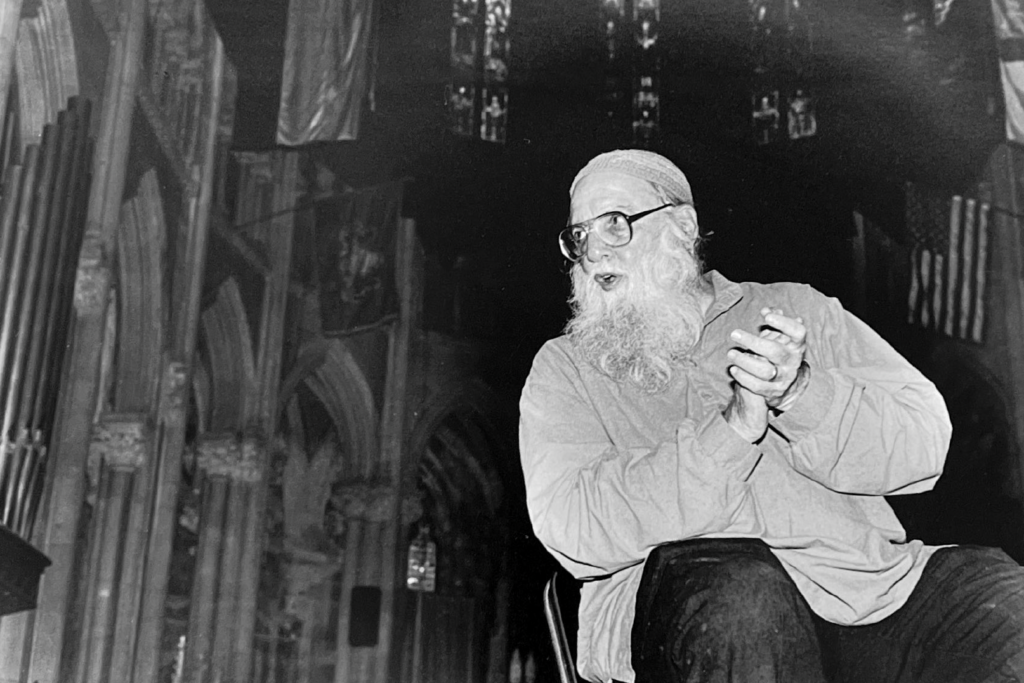
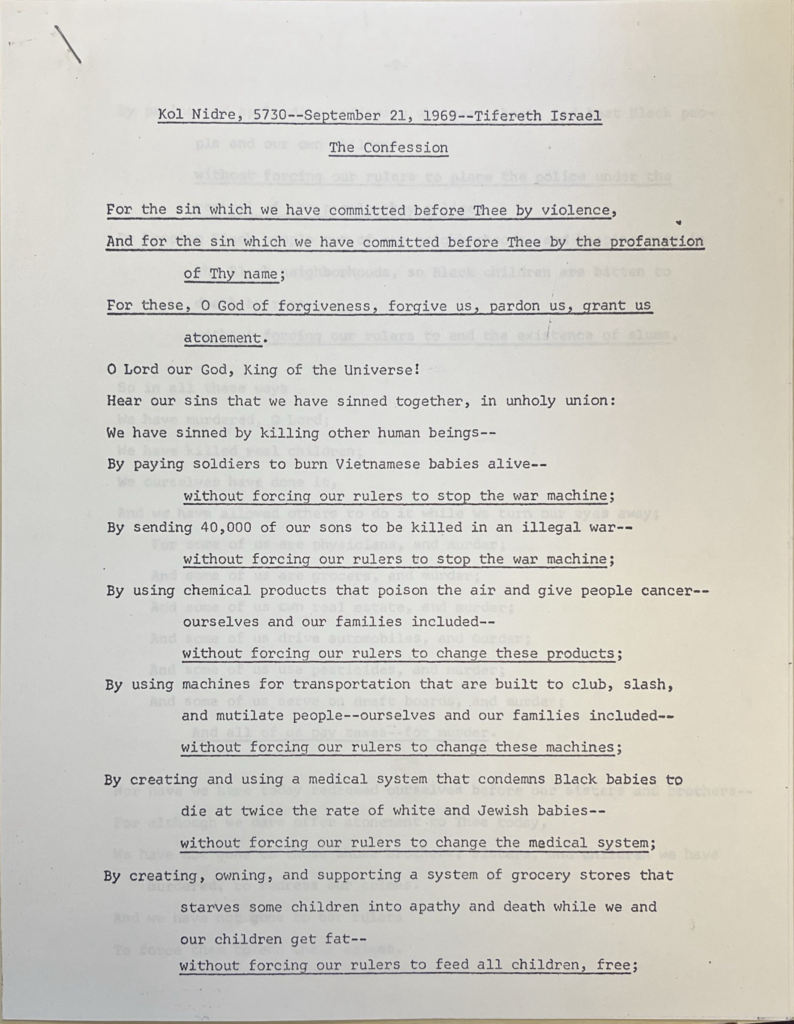
For the occasion, Waskow’s address called attention to the country’s collective “sins,” implicating his Jewish listeners in the violence he felt that they had tolerated. With evocative and severe language, he lamented, “we have sinned by killing other human beings – by paying soldiers to burn Vietnamese babies alive – without forcing our rulers to stop the war machine.” Opposing racism remained an urgent priority. Jews had sinned, he suggested, “by keeping Black people out of our neighborhoods” and failing to pressure the powers that be into “ending the existence of slums.” His presentation implored Jews to confront their own complicity in American racism and war, positing that true atonement required action:
“We have murdered, O Lord;
We have killed real children;
We ourselves have done it,
And we have allowed others to do it while we turn our eyes away;
For some of us are physicians, and murder;
And some of us are grocers, and murder;
And some of us own real estate, and murder;
And some of us drive automobiles, and murder;
And some of us use pesticides, and murder;
And some of us serve on draft boards, and murder;
And all of us pay taxes—for murder.
Nor have we here today redeemed ourselves before our sisters and brothers—for although we dare offer atonement to Thee today, we have not gone to those whose brothers, sisters, and children we have murdered, to redress our crimes. And we have not gone to our rulers to force them to end their crimes.”
After Waskow’s lecture concluded, some attendees drafted a report of the proceedings. While they noted a few outbursts, scuffles, and walkouts, ultimately “the congregation was orderly and peaceful throughout.” Many worshippers found that the address was “appropriate for a Yom Kippur service and worthy of their attention,” proving the event to be a “large blessing in a most unorthodox package.” While the struggles between the “Jewish establishment” and Jews for Urban Justice produced bitter rifts, the latter’s interpretation of Yom Kippur had begun to find a place within mainstream Jewish life. Radicals and non-radicals alike agreed that Yom Kippur represented a time for Jews to reckon with personal sins as well as their collective responsibility.