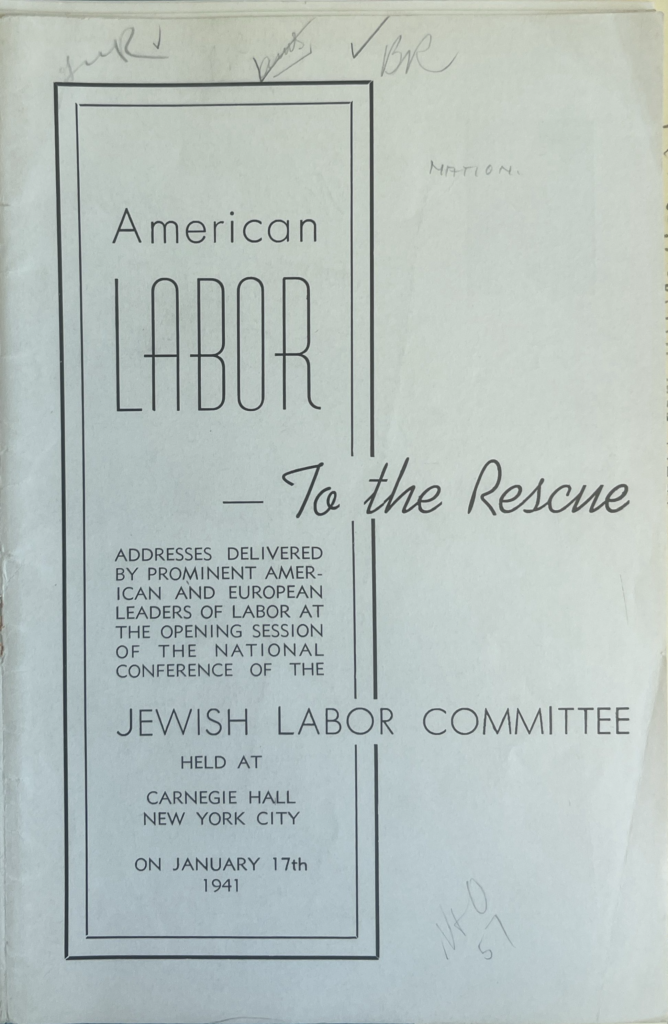
In October 1935, members of the Jewish Labor Committee (JLC) convened for only the second time to discuss a mounting crisis. “The Nazi government,” speakers warned, had already “exceeded all cruelties known to history in its attempt to establish itself and to insure for itself the spoils of victory.” Founded in New York City in 1934 by former Russian immigrants, the JLC was the product of members of the socialist Jewish Labor Bund who viewed Jewish self-defense and the rights of the proletariat as related causes. Leaders had participated in the Russian Revolution of 1905, when they joined an organized struggle of Yiddish-speaking workers to resist state oppression. Three decades later, they leaned on these traditions of activism as the Nazis threatened to destroy European Jews and the working-class Left.
While almost all of the major institutions of American labor were decidedly anti-fascist in the 1930s, the JLC and Jewish labor unions held a special interest in anti-Nazi organizing. Many JLC founders had personal contacts who remained imperiled in Europe, and they regularly expressed solidarity with their “brother Jews, who languish in the Nazi ghettos” and whose “agonies and cries of distress” had reached the United States. The JLC framed the fight against antisemitism and fascism as part of a broader labor practice of advocating “freedom and democracy,” anchored by progressive, decent-hearted “men and women everywhere.”
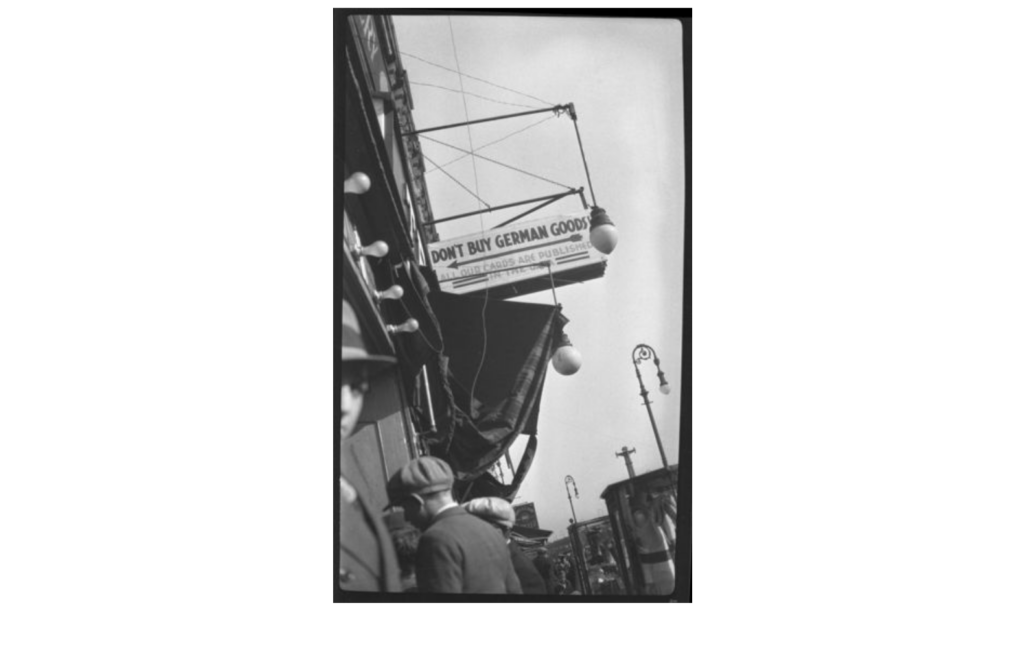
By highlighting Nazi crimes against workers, including the “ruthless cutting of wages” and the violent persecutions of German socialists and communists, Jewish labor activists corralled support from non-Jewish unions amidst a national climate of isolationism. The American Federation of Labor, then the premier alliance of labor unions, agreed to support the Jewish initiative of boycotting German goods in the early thirties. The JLC partnered with the American Jewish Congress to organize protests and promote the idea that “an effective weapon against Hitlerism is the boycott of German goods and services.” The boycott had a marginal impact on the German economy, but it strengthened the JLC’s ability to build coalitions and amass resources. In the early 1940s, the group used its fundraising profits to facilitate the rescue of over a thousand European labor leaders, most of whom were Jewish.
These commitments continued after the war, when American Jewish groups turned their efforts toward the rehabilitation of Jewish displaced persons (DPs). The JLC used its networks to pool together significant money for “general Jewish relief,” which entailed providing Jewish survivors of the Nazi genocide with material and moral support as they awaited their futures in German DP camps. American labor groups, including the heavily Jewish International Ladies Garment Workers’ Union, helped develop sanatoriums in Europe to bring “hundreds of sick and under-nourished children back to healthy and normal life.” The JLC further promoted an adoption program, calling upon its labor allies to take in orphaned Jewish children. Landsmanshaftn (Jewish immigrant societies), along with members of Jewish trade unions including the Workmen’s Circle, heeded the call and provided young DPs with “proper care and sustenance” in their new homes.
Given their labor origins, JLC leadership also demonstrated a particular interest in finding reliable work for Jewish DPs who landed in America. Members conducted rigorous studies to ascertain the “backgrounds and occupational skills” of DPs to find them appropriate jobs. The Committee made substantial financial contributions to vocational training programs, which were essential tools for Jewish newcomers who navigated unsympathetic government policies that threatened to deport “public charges.” By 1950, the JLC boasted that many “newly-arrived immigrants have become productive workers with a new lease on life.” Hundreds had become “active in trade unions and Workmen’s Circle branches,” continuing the legacy of Jewish labor in the United States.
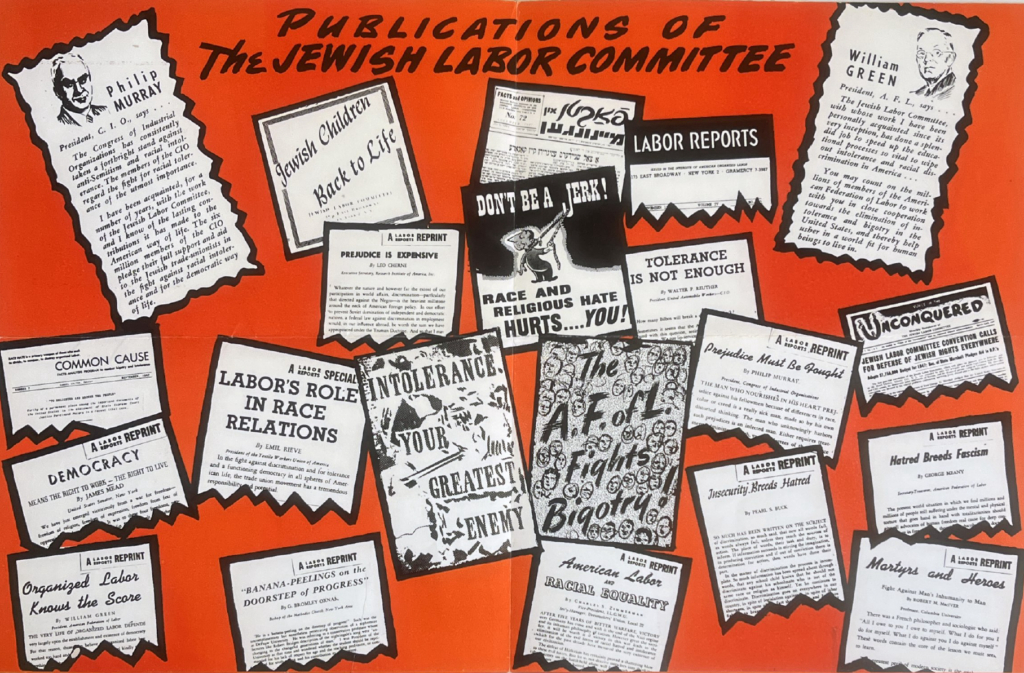
Many Jewish survivors recognized the JLC’s efforts to help them rebuild their lives. In 1951, a group of over 300 Jews who settled in Australia penned a letter of gratitude to the organization, writing, “we, Jews of Hungary, Italy, Belgium, Germany, Czechoslovakia, Yugoslavia, Austria, Poland, France, Sweden unanimously resolved at a general meeting to extend our thanks to the Jewish Labor Committee for their kind and brotherly aid in helping us settle in a free land where we may resume once more a healthy and productive existence.” For years after the war, the JLC continued to campaign against antisemitism and other forms of bigotry, believing that racial intolerance and class inequality were inextricably linked. The JLC’s story, represented in the Jewish Labor Committee Collection, exemplifies how American Jewish activists harnessed their standing in the labor movement to successfully lobby for humanitarian causes.