Sukkot is a seven-day harvest festival during which Jews sit, eat, and gather with family. The holiday commemorates the agricultural harvest and the Israelites’ journey through the wilderness following the Exodus. The American Jewish Historical Society holds several collections of personal papers and organizational records illuminating the ways in which Sukkot has inspired gathering on a larger scale, reaching beyond family to invite members of the wider community to gather together.
The AJHS’ library holds several volumes dedicated to the holiday of Sukkot, including The Sukkot and Simhat Torah Anthology by editor Philip Goodman. The anthology includes references found in historic and religious texts, such as the Hebrew Bible, and Talmud, and carries into the modern era by providing various examples of poetry, short stories, and personal reflections. The texts share common themes of service and sharing with others, as well as the natural abundance and beauty associated with the harvest season. Goodman’s anthology illustrates how the observation of Sukkot has evolved and changed over time and how practices have differed across the globe. According to Goodman, lanterns were a common decoration in Europe during the Middle Ages, and in nineteenth century Germany hand-painted murals were the custom. Colonial America, specifically Barbados, was noted for its use of foliage, palm branches, and ribbons.

Two archival collections at AJHS provide more recent examples of Sukkot: the Goldie Milgram Papers and the Jack D. Weiler and Family Papers, which contain materials documenting the ‘Sukkah in the Sky.’ The former contains material from Project Kesher, founded in 1989 to assemble Jewish women around the world, as well as Ma’yan: The Jewish Women’s Project, a program devised in 1993, as part of the Jewish Community Center on the Upper West Side. Project Kesher provides materials in the form of prayers and songs, whereas Ma’yan was created to support female leadership in Jewish ritual. Their program for Sukkot, titled “Welcoming the Ushpizot” provides activities related to the celebration of Sukkot, while connecting it to a broader understanding of Biblical women, historical Jewish women, and the participants’ own lives.
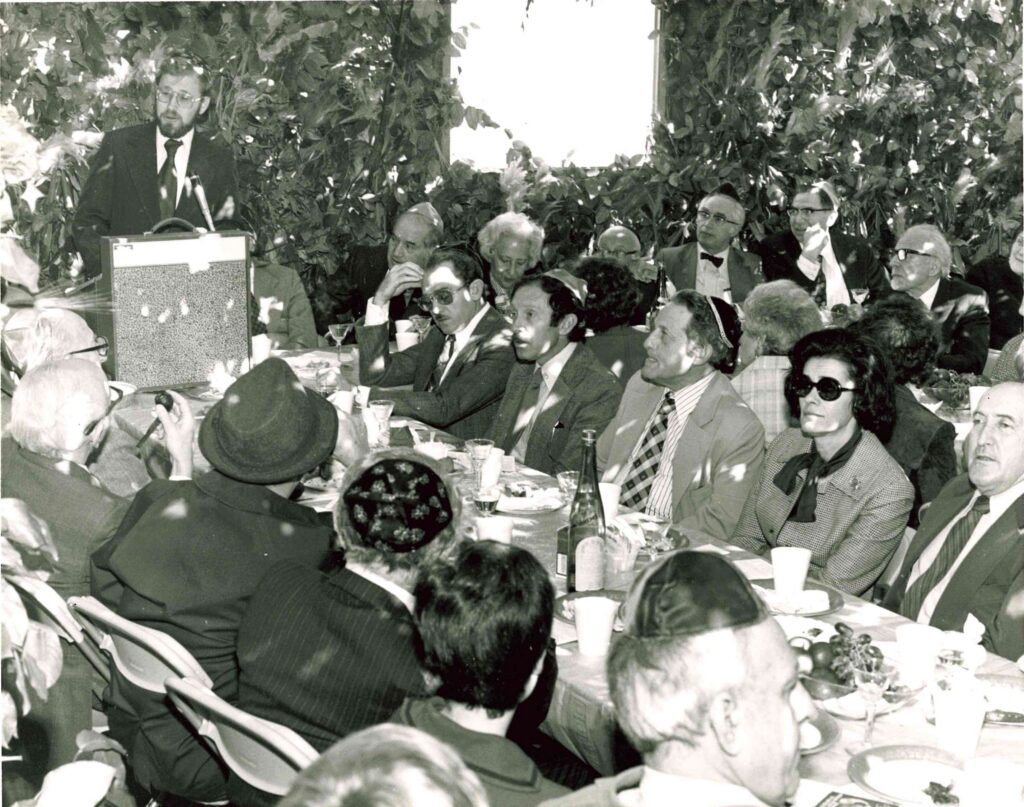
The ‘Sukkah in the Sky,’ was an ambitious and celebratory practice hosted by realtor and philanthropist Jack D. Weiler alongside his son Alan Weiler and son-in-law Robert Arnow. For 23 years, from 1972 to 1995, the family would construct a large sukkah on the roof of the Grace Building on 43 West 42nd Street in Manhattan. The temporary structure was large enough to seat 125 people and would host several meetings and events in the week between Yom Kippur and Simchat Torah. Guests included the heads of notable Jewish Organizations, philanthropists, politicians and other real estate professionals.
Jack D. Weiler Papers (P-1045)
____________________________________________________
Sources
Goldie Milgram Papers (P-885). Box 6, Folder 1. Sukkot and Simhat Torah, 1956, 1979-1998.
Goodman, Philip. (1973). The Sukkot and Simhat Torah anthology. The Jewish Publication Society.
Jack D. Weiler and Family Papers (P-1045). Box 8, Folders 5-6. Sukkah in the Sky from 1972-1991.