
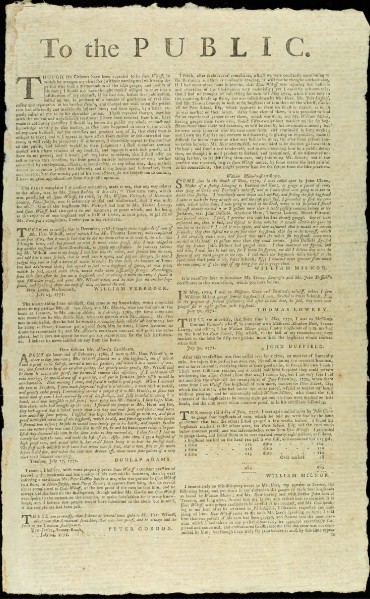
Public debates have occurred between people since time immemorial. According to scholar Davide Napoli, antilogy, the delivery of two opposed speeches in a public venue, was a major pastime in ancient Greece (Blackwood, 2025). Greeks would amass in venues or private domiciles to hear intellectuals debate a range of subjects (Blackwood, 2025). As populations grew and ideas needed to be shared, the open forum transitioned to include newspapers, yet the diversity of topics has always remained. One notable example from newspaper open forums were The Federalist Papers and The Anti-Federalist Papers. The Federalist Papers were a series of essays written by founding fathers Alexander Hamilton, John Jay, and James Madison between October 1787 and May 1788. The essays were published anonymously, under the pen name “Publius,” in various New York state newspapers of the time (Library of Congress). The essays urged New Yorkers to ratify the newly written Constitution of the United States. The Anti-Federalist Papers were written by opponents of ratification of the Constitution. In the archive of the American Jewish Historical Society, we get a glimpse of an argument occurring in a similar way, through a series of published open letters in The Pennsylvania Journal. The debate instigated a challenge to a duel.
The altercation in question began in the mid-18th century between Moore Furman and Isaac Wikoff. Both men were prominent merchants in the middle colonies and, at one-point, quite close. In a letter Wikoff wrote to Furman, “I esteemed you one of my best friends…” (The Pennsylvania Journal, 1771b). During the Revolutionary War, Furman was the Deputy Quarter Master General for New Jersey, playing a major role in procuring and organizing supplies for the Continental Army and was also the first mayor of Trenton (Hitchcock, 1912). The dispute began when Furman received complaints from his customers in Philadelphia and Trenton regarding the purity of Wikoff’s rum. In reaction, Furman publicly accused Wikoff of selling adulterated rum. In response, an insulted Wikoff challenged Furman to a duel to be held on July 22, 1771. Wikoff’s challenge reads:
“I declare that you will meet me tomorrow morning at five o’clock, on Petty’s Island, with one friend only, where we may finally settle this matter between us; and may Providence determine in favor of the Innocent… Should you have any objection to the time or place, you may chuse [choose] any other; which will be agreeable to Monday morning, July 22, 1771.” (The Pennsylvania Journal, 1771b).
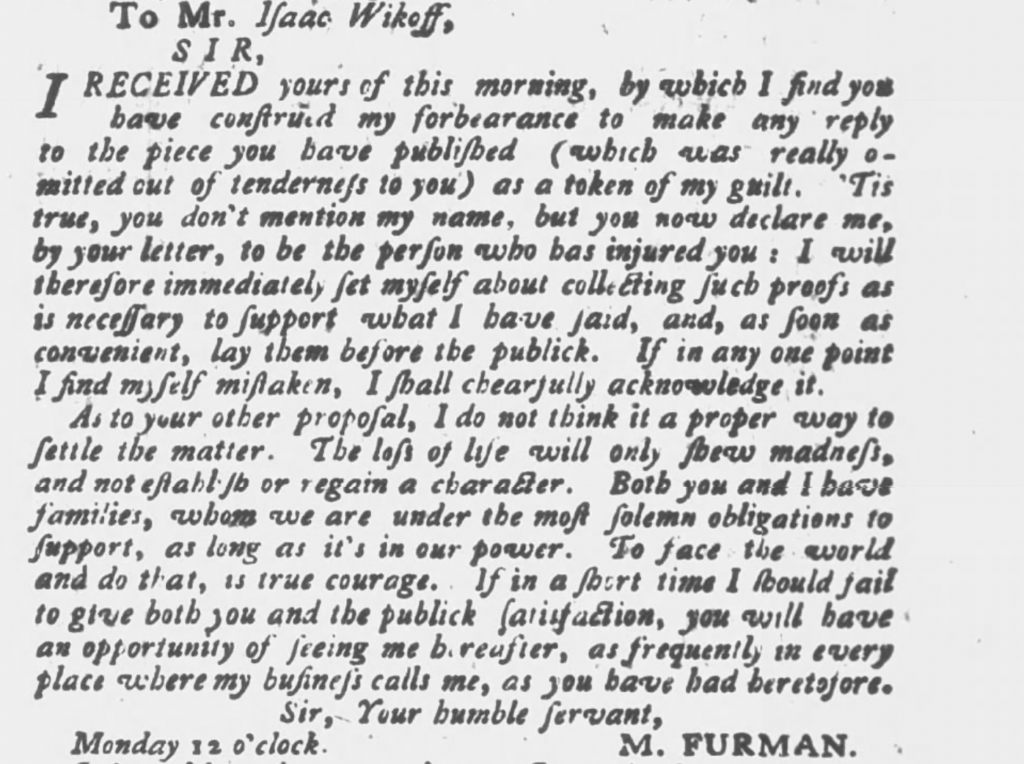
Furman denied Wikoff’s challenge, responding with a letter reading: “The loss of life will only show madness and not establish or regain a character.” (The Pennsylvania Journal, 1771b). Wikoff would not be ignored. The day after this exchange, the two met in a local cafe where after a short conversation, Furman made no apologies and the men brawled (The Pennsylvania Journal, 1771b). Furman cited both men’s commitments to supporting their families as a main reason to deny the duel but was also committed to upholding his reputation. Furman includes the following in his response to the challenge:
“…you now declare me, by your letter, to be the person who has injured you; I will therefore immediately set myself about collecting such proofs as is necessary to support what I have said, and, as soon as convenient, lay them before the publick [public].” (The Pennsylvania Journal, 1771b).
Furman and Wikoff’s feud remained private until July 31, 1771, when Furman published a statement, To the Public in The Pennsylvania Journal in defense of his character and proof of his indictment of Wikoff’s rum. As evidence, Furman had collected ten testimonies from Wyckoff’s customers in the form of certificates and letters, each detailing the terrible quality of the rum and other seemingly nefarious business dealings. One certificate involved William Verbryck, who had purchased three hogheads (a large barrel) of rum from Wikoff in December of 1768 and lent one of them to another man, Thomas Lowery. Lowery complained the rum “…was so bad that he did not know what to do with it…” and Verbryck said, “…I judged they had at least a barrel of water in each…” (The Pennsylvania Journal, 1771a). Verbyck had complained to Wikoff about the adulterated rum, who in turn blamed the boatmen or “Shallop-men” delivering the goods from Philadelphia to Trenton. A customer named Peter Gordon had a similar complaint, writing “… I have at several times spoke to Mr. Isaac Wikoff, about rum that I received from him, that was low proof, and he always laid the fault on the Trenton Shallop-men.” (The Pennsylvania Journal, 1771a). Additionally, a man named William Milnor was called upon to gauge four hogheads of rum. His account reads, “I proceeded to gauge them and found them to be over marked twenty-eight gallons…” (The Pennsylvania Journal, 1771a).
Though Furman had published the certificates of complaint in July, Wikoff didn’t respond until October of the same year. He addressed each accusation in a four-page spread of The Public. In reference to the hogshead of rum that Verbryck had lent to Thomas Lowery, Wikoff states:
“Mr. Lowrey has given me leave to declare that was near all sold before he heard any complaint of it, and that he sold the whole of it unaltered in its quality at the same price he sold other rum at…” (The Pennsylvania Journal, 1771a).
Later in the letter, Wikoff presents his own certificate from Gordon that reads:
“…I never mentioned to Messrs. Furman and Hunt that Mr. Isaac Wikoff laid the fault on the shallop men, of adultering his rum… and I never found fault with the quality of the rum, but only that it was low proof” (The Pennsylvania Journal, 1771a).
In response to Milnor’s measurement of his hogheads, Wikoff details an instance when another customer of his, Mr. George Meade, gauged a hogshead he bought from Wikoff and found that his measurement was so disparate from what he was sold that he was sure it was a mistake. Meade had three more men gauge the hogshead and each resulted in a differing figure. It appears that the system of measurement for gauging the volume of rum was incredibly inconsistent and could easily be a source of misunderstanding.
Outside of the open debate found in The Pennsylvania Journal there is no additional evidence to support the reliability of either man’s account. Testimonies and complaints vary greatly on both sides of Furman and Wikoff’s disagreement, rendering it difficult to come to a verdict on the truth. What is clear, the gentlemen involved were passionate about their subject, and when challenged, fiercely defended their reputations – almost to the death.
A digital version of Moore Furman’s “To the Public” can be viewed here.
____________________________________________________________
Sources
“Anti-Federalist Papers.” n.d. Ballotpedia. Accessed July 29, 2026. https://ballotpedia.org/Anti-Federalist_papers.
Blackwood, Kate. 2025. “Public Speeches Challenged Assumptions in Ancient Greece | Cornell Chronicle.” Cornell Chronicle. https://news.cornell.edu/stories/2025/10/public-speeches-challenged-assumptions-ancient-greece.
Furman, Moore. 2026. “‘To the Public Though the Citizens Have Been Appealed to by Isaac Wikoff, in Which He Arraigns My Character (Without Naming Me) With Being the Person Who Took a Memorandum of the False Gauges, and Quality of Rum …’ By Moore Furman, 1771.” Cjh.Org. 2026. https://digipres.cjh.org/delivery/DeliveryManagerServlet?dps_pid=IE13688227.
Library of Congress. 2019. “The Federalist Papers: Primary Documents in American History.” Loc.Gov. Library of Congress. https://guides.loc.gov/federalist-papers/full-text.
“The Letters of Moore Furman, Deputy Quarter-Master General of New Jersey in the Revolution : Furman, Moore, 1728-1808. [From Old Catalog] : Free Download, Borrow, and Streaming : Internet Archive.” 2026. Internet Archive. 2026. https://archive.org/details/lettersofmoorefu00furma/page/n11/mode/2up. Wikoff, Isaac. 1771. “To the Public.” The Pennsylvania Journal , October, 8–9. https://www.newspapers.com/image/1034010163/?match=1&terms=moore%20furman.