

At the Center for Jewish History, visitors can currently view the American Jewish Historical Society’s exhibition The Jack Kirby Way: How a Boy From the Lower East Side Became the King of Comics, on view through November 30, 2026. Kirby was the co-creator of the Marvel Universe and its pantheon of superheroes, and the exhibition shares over 70 of his iconic works. Tucked in the stacks of the AJHS archive is a comic book created in a similar style of primary colors and Ben-Day dots, but preserved for a different purpose. Produced in 1945 for politician William O’Dwyer’s mayoral campaign, it tells a sensationalized account of his life to court the city’s electorate.
Born in County Mayo, Ireland, in 1890, William O’Dwyer immigrated to New York City in 1910, as part of the mass migration of Irish, Italian, and Jewish immigrants between 1840 and 1924. O’Dwyer arrived with only twenty-five dollars in his pocket, according to an apocryphal story. He began his career as a manual laborer, working as a steamship stoker, handyman, and delivery boy. Eager to advance beyond his humble beginnings, he joined the New York City Police Department (NYPD) in 1917 while taking night classes at Fordham University to earn his law degree.
O’Dwyer swiftly earned a reputation for his hard work and judiciousness as an NYPD officer. In 1939, he was appointed Kings County District Attorney, where he achieved national recognition for prosecuting Murder, Inc., a notorious crime syndicate responsible for an estimated 400 to 1,000 contract killings. O’Dwyer made his first bid for mayor in 1941, losing to then-incumbent Fiorello La Guardia, and soon after enlisted in the United States Army during World War II. He eventually attained the rank of Brigadier General.
When the 1945 mayoral election season arrived, O’Dwyer’s legal victories and wartime service had built him a formidable reputation from which to launch a renewed campaign. His candidacy occurred in a rapidly shifting political and urban landscape. In postwar New York, mob bosses wielded significant power, crumbling tenement apartments sat only miles away from chic penthouses, and fierce ethnic voting blocs of Irish, Italian, and Jewish Americans jockeyed for influence. O’Dwyer’s platform had a broad appeal in this political climate. He pledged to support returning soldiers, construct new expressways and bridges, and use local city funds to keep struggling daycares open for working mothers.
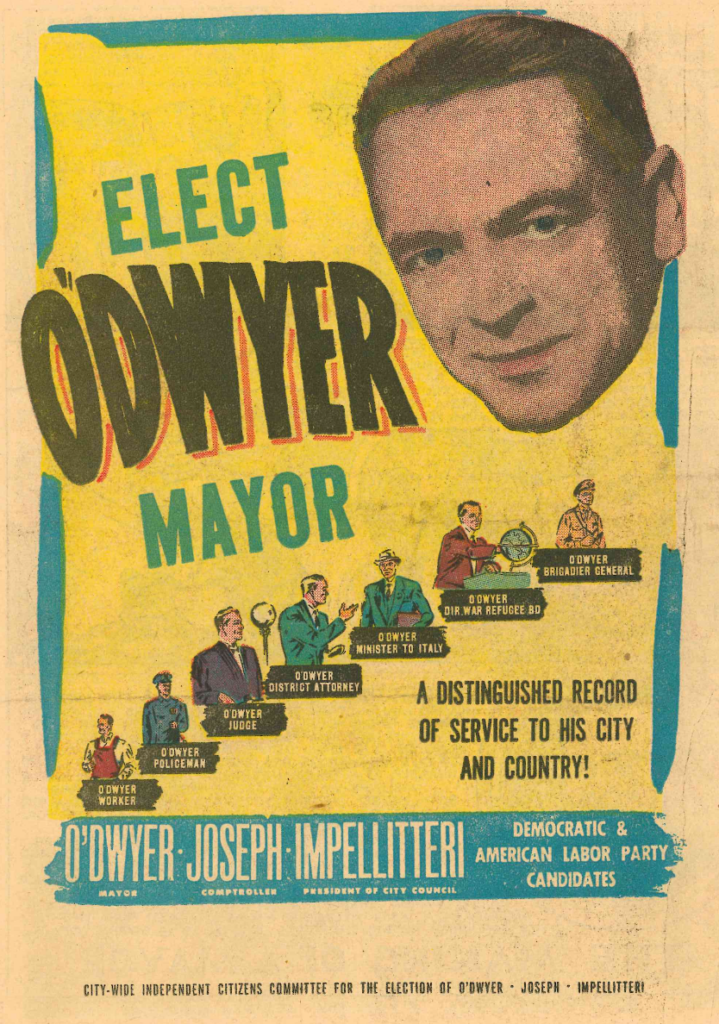
The aforementioned comic book—found in the Jonah J. Goldstein papers—exemplifies O’Dwyer’s eclectic campaign strategy. The comic traces a relatable yet mythic account of O’Dwyer’s life. It follows his evolution from Irish countryman to scrappy immigrant and American soldier, casting mayorship as the natural next chapter of his journey.
O’Dwyer’s main opponent in the race was Jonah J. Goldstein, a lawyer born in 1886 to a Canadian Jewish family. Goldstein ran on the Republican Liberal City Fusion and finished in second place to O’Dwyer’s first. Although his political campaign failed, Goldstein helped advance the city in other ways. His law firm was among the earliest in New York City to hire Black and female attorneys. His wife, Harriet B. Lowenstein, was the first woman in New York State to become both a lawyer and a certified public accountant. While it is unknown exactly why Goldstein so carefully preserved his rival’s campaign comic, perhaps he wanted to study O’Dwyer’s victorious strategy.
O’Dwyer delivered on many of his promises during his first term. He constructed new schools, daycare centers, hospitals, and playgrounds. The Daily News and The New York Times regularly penned glowing reviews of his mayorship, the former calling him “100 percent honest.” When O’Dwyer ran for reelection in 1949, his massive public works achievements clinched the vote. Yet, in a twist worthy of a comic book arc, O’Dwyer’s reputation would soon collapse.
On the morning of December 11, 1949, New Yorkers awoke to a galling article splashed across the front page of the local newspaper, the Brooklyn Eagle. The article, entitled “Lucrative Borough Rackets Feed Vast Crime Syndicate,” was the first installment of an eight-part investigation by veteran reporter Ed Reid. Reid had discovered that a gambler named Harry Gross was running a million-dollar illegal sports betting ring, while high-ranking New York City police inspectors were taking massive payoffs to hide the crime. While Reid’s early reporting did not implicate the mayor, it triggered an investigation by Brooklyn District Attorney Miles McDonald, which would soon embroil the mayor and his inner circle. McDonald was known as a man of high moral standing during a time of rampant corruption. He was perceived as a straight-arrow prosecutor who hunted for truth and justice with the resolve of a film noir character.
Over the following months, McDonald’s investigation narrowed in on James Moran, O’Dwyer’s longtime personal aide. Moran had taken thousands of dollars in cash bribes to protect Gross’ illegal activity. To the many Brooklyn Eagle readers following the case, it only seemed a matter of time before the mayor himself would be handcuffed and brought before a jury.
Enter into the story none other than President Harry S. Truman. Truman expediently offered O’Dwyer an appointment as the U.S. Ambassador to Mexico in an effort to protect the national reputation of the Democratic Party from a catastrophic organized crime scandal. Despite the suspicion surrounding O’Dwyer’s sudden departure, many New Yorkers remained committed to his mayorship. A staggering crowd of 300,000 people gathered at City Hall to attend his farewell parade. O’Dwyer’s time in Mexico was largely successful; he was fluent in Spanish, and he rapidly became popular among the local residents and American expatriate community.
The truth finally caught up to O’Dwyer the following year. In 1951, the Senate’s Special Committee to Investigate Crime in Interstate Commerce (the Kefauver Committee) came to New York to investigate political ties to the mob. Forced to return from Mexico to testify under oath, O’Dwyer saw the credibility of his “100 percent honest” image decline. A former union head attested that he had personally handed O’Dwyer a ten thousand dollar cash bribe inside Gracie Mansion. Further testimony revealed that O’Dwyer and James Moran had been holding secret meetings with notorious American mafia syndicate boss Frank Costello since 1941.
James Moran was ultimately sentenced to prison, but O’Dwyer nonetheless managed to evade jail time, thanks in part to the previous presidential cover. O’Dwyer returned to his long-lost home of New York City in 1960. By then, the public’s fury over the mid-century gambling scandals had abated.
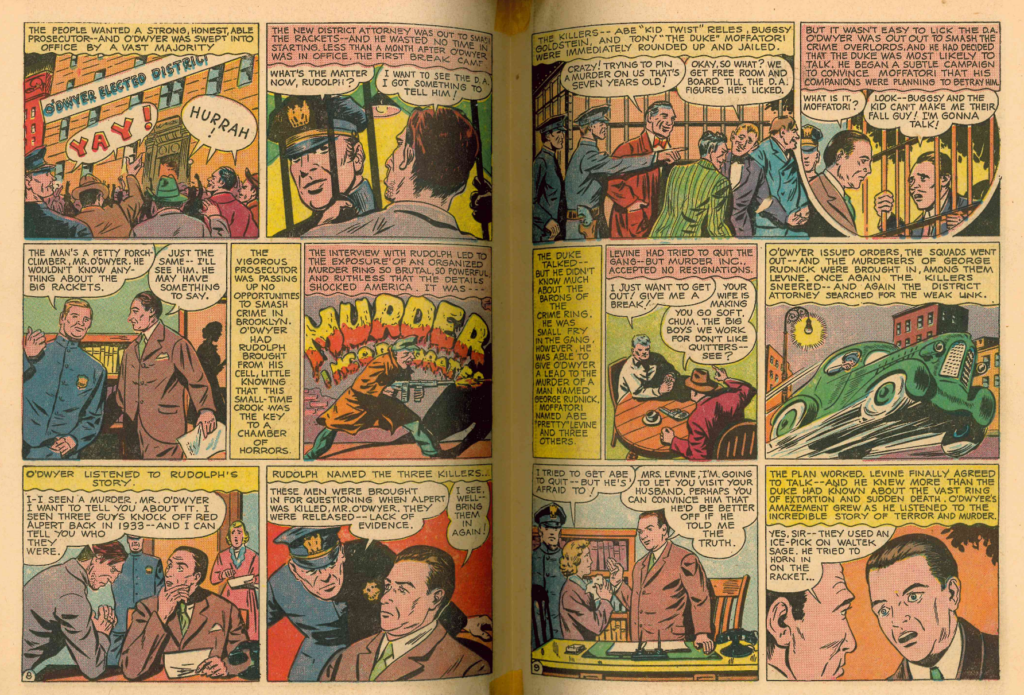
While William O’Dwyer has largely become a forgotten figure in the history of the city, the comic book preserved in the AJHS archives serves as a paper-and-ink reminder of his place in the annals of New York. If readers are curious to learn more about Jack Kirby’s life and how it influenced his legendary career, watch this short video of AJHS Trustee Roy Schwartz discussing the topic: https://www.youtube.com/shorts/E9FnAU7_jAQ.