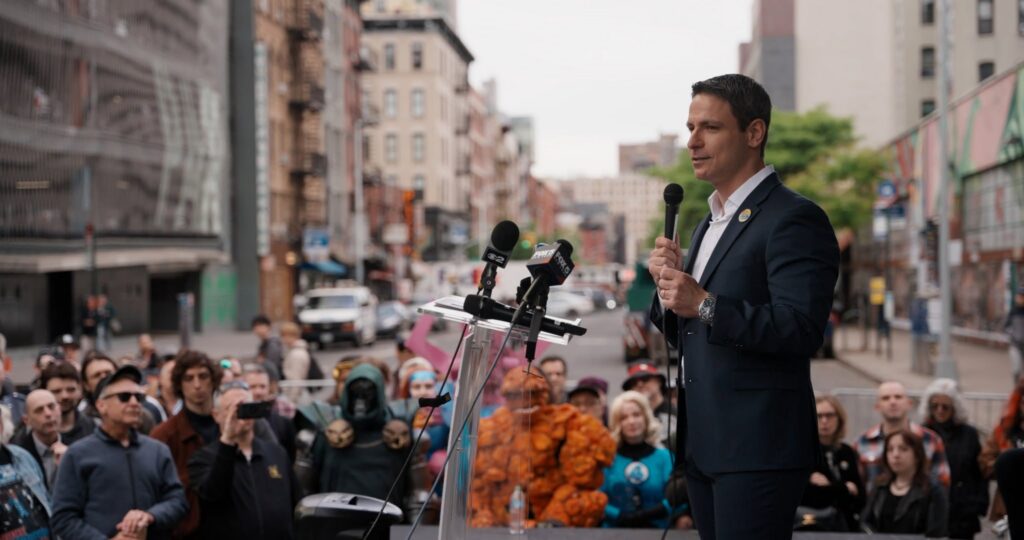
Jack Kirby, born Jacob Kurtzberg (1917–1994), is the co-creator of the Marvel Universe and its pantheon of superheroes. On May 11, 2026, New York City dedicated Jack Kirby Way, naming the block of Essex Street between Delancey and Rivington Streets in his honor. Opening that same day, an exhibit presented by the American Jewish Historical Society and Jack Kirby Museum & Research Center, The Jack Kirby Way: How a Boy From the Lower East Side Became the King of Comics opened at the Center for Jewish History. The exhibition, now on view though November 30th, was curated by Rand Hoppe, founding director of the Kirby Museum, and Roy Schwartz, AJHS Trustee and pop culture historian, with consultation by AJHS’s Dr. Andrew Sperling. The exhibit marks the first time Kirby’s own origin story is told in full; how his Jewish upbringing, childhood on the Lower East Side in the 1920s and 1930s, and wartime experiences shaped his work—and how these influences can be found, often as thinly-veiled metaphors, in some of the most famous characters and stories in the world.
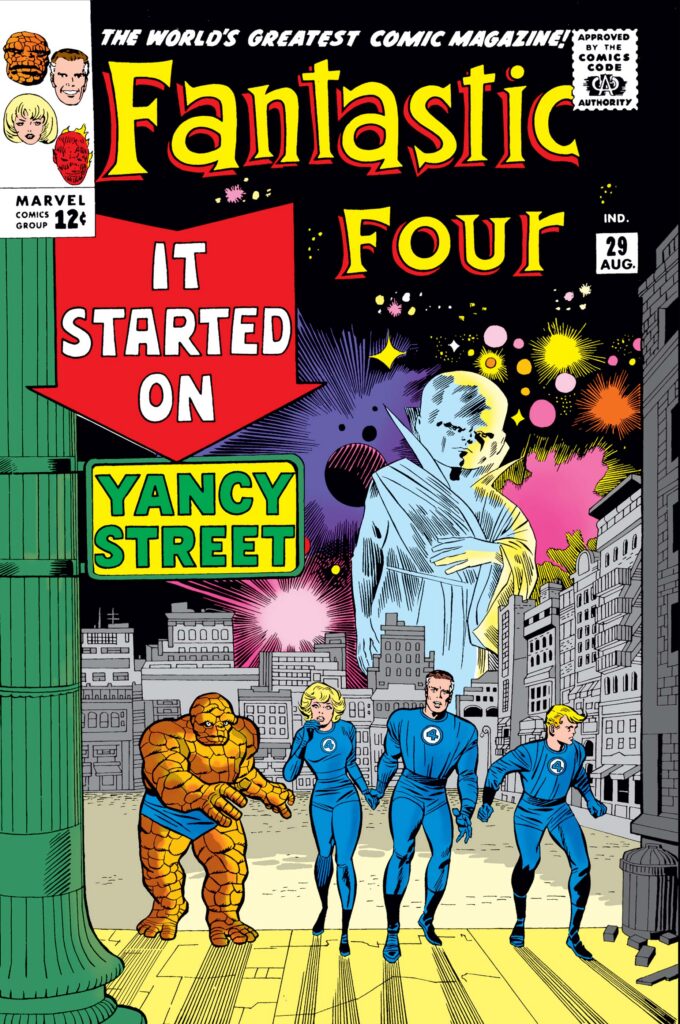
To add to the festivities on May 11th, Marvel held a private reception in Kirby’s honor at the Society of Illustrators in Midtown Manhattan. Guests received a special edition comic, limited to 500 copies, Celebrating Jack Kirby Way. The comic is a reprint of Fantastic Four #29—the classic story “It Started on Yancy Street!”—with a new cover and two essays, one by Rand Hoppe and one by Roy Schwartz. Roy’s introduction essay explores Kirby’s connection to the street that now bears his name. We are delighted to share that essay (below) with AJHS readers.
It Started on Delancey Street!
Turns out, it’s not easy changing a street name in New York City.
They don’t do it for just anyone. The red tape is enough to encircle Galactus’s Worldship, but the person must also be of significant historical importance. He or she must have a strong connection to New York, the neighborhood and community, and the street. Without question, Jack Kirby is all those things.
Jack Kirby was born Jacob Kurtzberg on August 28, 1917, at 147 Essex St. on the Lower East Side. It was a poor immigrant neighborhood then, rife with hardship and crime even before the Depression hit. Kirby’s relationship with it was complicated. He hated it, as he said on many occasions, but it also shaped his attitude and worldview, and he’d keep revisiting it in his work throughout his career.
He ruminated in Will Eisner’s The Spirit magazine #39 (July 1982); “I wanted to break out of the ghetto… It wasn’t a pleasant place to live in, crowded, no place to play ball. You became a toreador at an early age, just dodging the ice wagons… I was fearful of it… I think the ghetto leaves a life-long—I don’t know whether to call it a scar or an experience… It gave me a fierce drive to get out of it… In an immature way, I fantasized a dream world more realistic than the reality around me.”
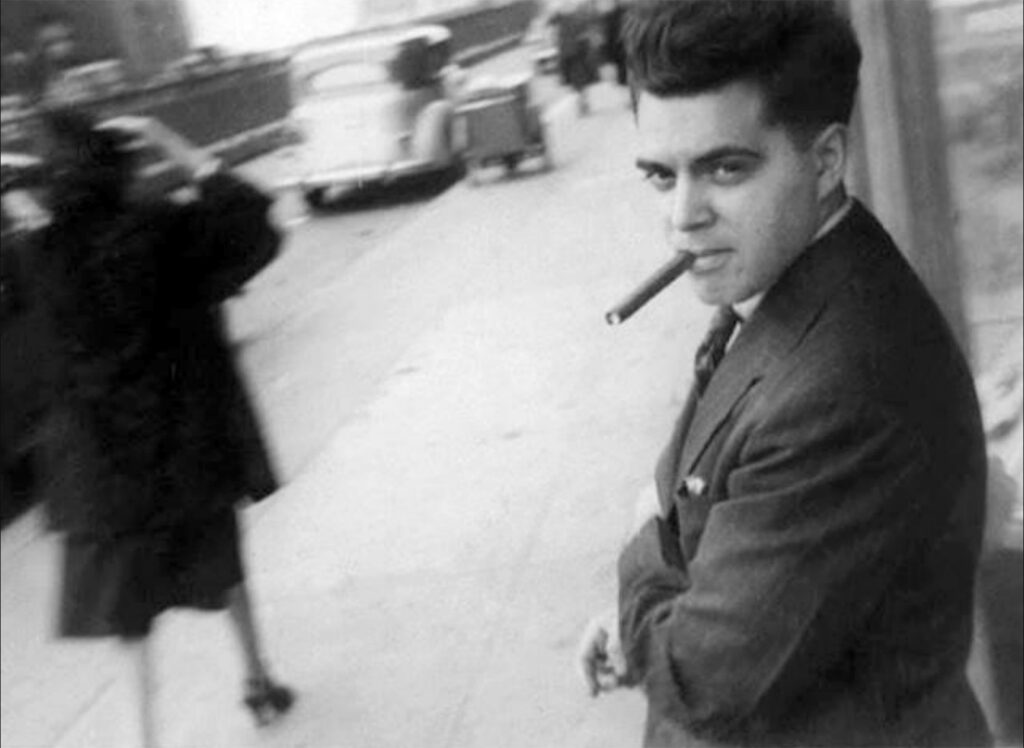
The Lower East Side was the crucible of Kirby’s imagination and artistic vitality. In many ways, it’s where Marvel was born.
Kirby’s after-school activities included roaming the neighborhood as a member of the Suffolk Street Gang, a group of delinquents that would get into scrapes with other local gangs. The Lower East Side streets were too busy, and so they often fought above them, across the huddled tenement rooftops. In Comics Journal #134 (February 1990), he described, “We’d chase each other up and down fire escapes, over rooftops, and we’d climb across clotheslines.”
To help put food on the table, Kirby also worked as a newsboy around the neighborhood. That’s where he came across the comic strips of Milton Caniff, Chester Gould, Hal Foster, and Alex Raymond, inspiring him to become a cartoonist.
He joined the Boys Brotherhood Republic on 3rd Street, a social organization that kept at-risk youth off the streets, where he was made editor and cartoonist of the member-run newspaper.
He would later combine these influences to create with Joe Simon a whole genre of kid gangs, like the Young Allies, Boy Commandos, Boy Explorers, and especially the Newsboy Legion—a group of Nazi-fighting paperboys from “Suicide Slum,” clearly the Lower East Side.
Kirby credited his childhood brawls, combined with his combat experience in WWII, for informing the famous fight choreography of his characters. He also helped popularize rooftop fights, a super-hero trope today.
In fact, a surprising amount of Kirby’s rich body of work is autobiographical. “If you look at my characters, you’ll find me,” he told Entertainment Tonight in 1982. “No matter what kind of character you create or assume, a little of yourself must remain there.”
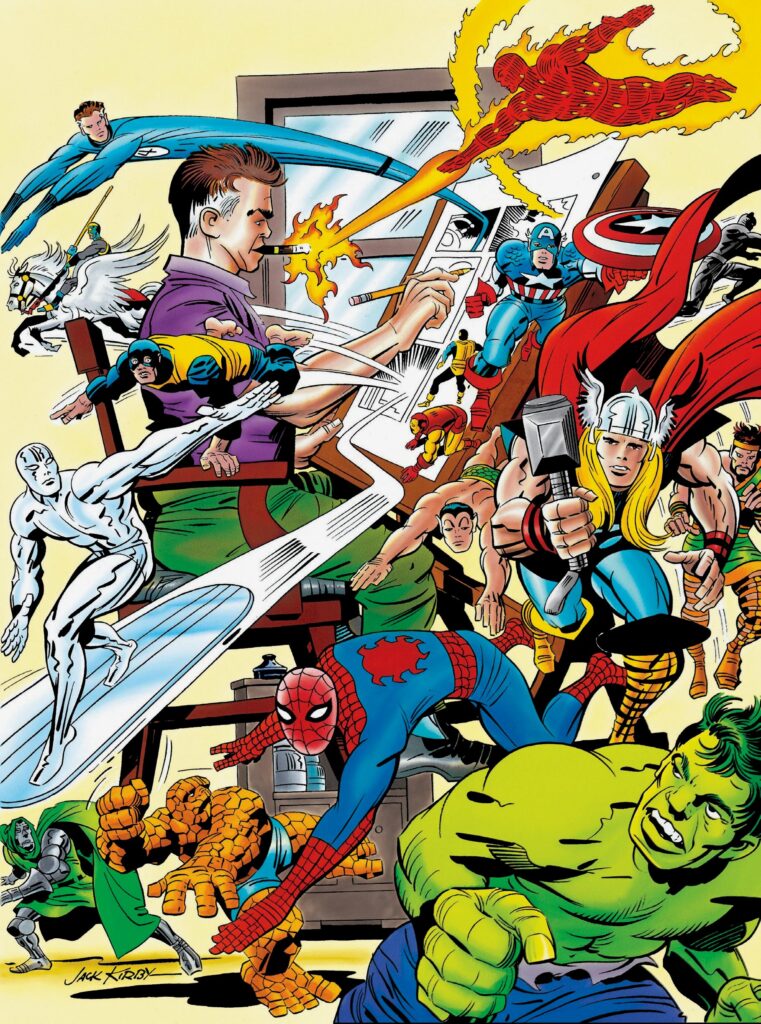
The most notable Marvel characters based on Kirby, in some way or another, are Nick Fury, Captain America, and the Thing.
The Cap parallels aren’t as well known, but Kirby plainly stated in a 1982 interview for the Detroit Jewish News, “Captain America was me, and I was Captain America.”
This embodiment of America isn’t from a Mayflower family or the heartland: He’s the child of immigrants from the Lower East Side, just like Kirby (before the movie changed it to Brooklyn). Steve Rogers’ early life is based directly on Kirby’s: a runt with a natural talent for art and a love of books, especially fantasy, which he keeps secret to avoid bullying (elements developed largely later by Roger Stern and John Byrne).
But really, the character that’s clearly Jack Kirby is Ben Grimm.
The Thing is a self-caricature; a working-class, cigar-chomping, gruff but kindhearted, thick-browed brawler. He’s even named Benjamin Jacob, after Jack and his father.
At first Kirby was coy about it in interviews and convention panels, but eventually he confessed. “If you’ll notice the way the Thing talks and acts, you’ll find that the Thing is really Jack Kirby,” he said on the TV show Prisoners of Gravity in 1993. “He has my manners, he has my manner of speech, and he thinks the way I do.”
Together with Stan Lee, Kirby also incorporated elements from his life into Grimm’s. The Fantastic Four’s breakout star comes from Yancy Street on the Lower East Side, a play on Delancey Street. He grew up poor and fell in with the Yancy Street Gang before joining the air force in World War II to become a decorated fighter pilot—a more glamorous version of Kirby’s experience as an infantryman, where he was awarded the Bronze Star.
You’ll also notice that the Thing, despite living in the swanky Baxter Building and embarking on grand adventures in outer space and the Negative Zone, keeps returning to his old neighborhood. Yancy Street is a prominent location in FF lore, in the comics as well as in Marvel Studios’ Fantastic Four: First Steps. It doesn’t take Freud to realize Kirby was working out his issues through the character.
Kirby’s parents were Jewish immigrant-refugees from Austria-Hungary (today Ukraine), and Kirby kept hinting that the Thing, his avatar, was also Jewish, though it would take decades to become explicit. Finally, in Fantastic Four #56 (August 2002), by Karl Kesel and Stuart Immonen, Grimm visited Yancy Street to reveal that not only is he Jewish, but he keeps a Star of David necklace in his “4” insignia hollow belt buckle. Talk about symbolism.
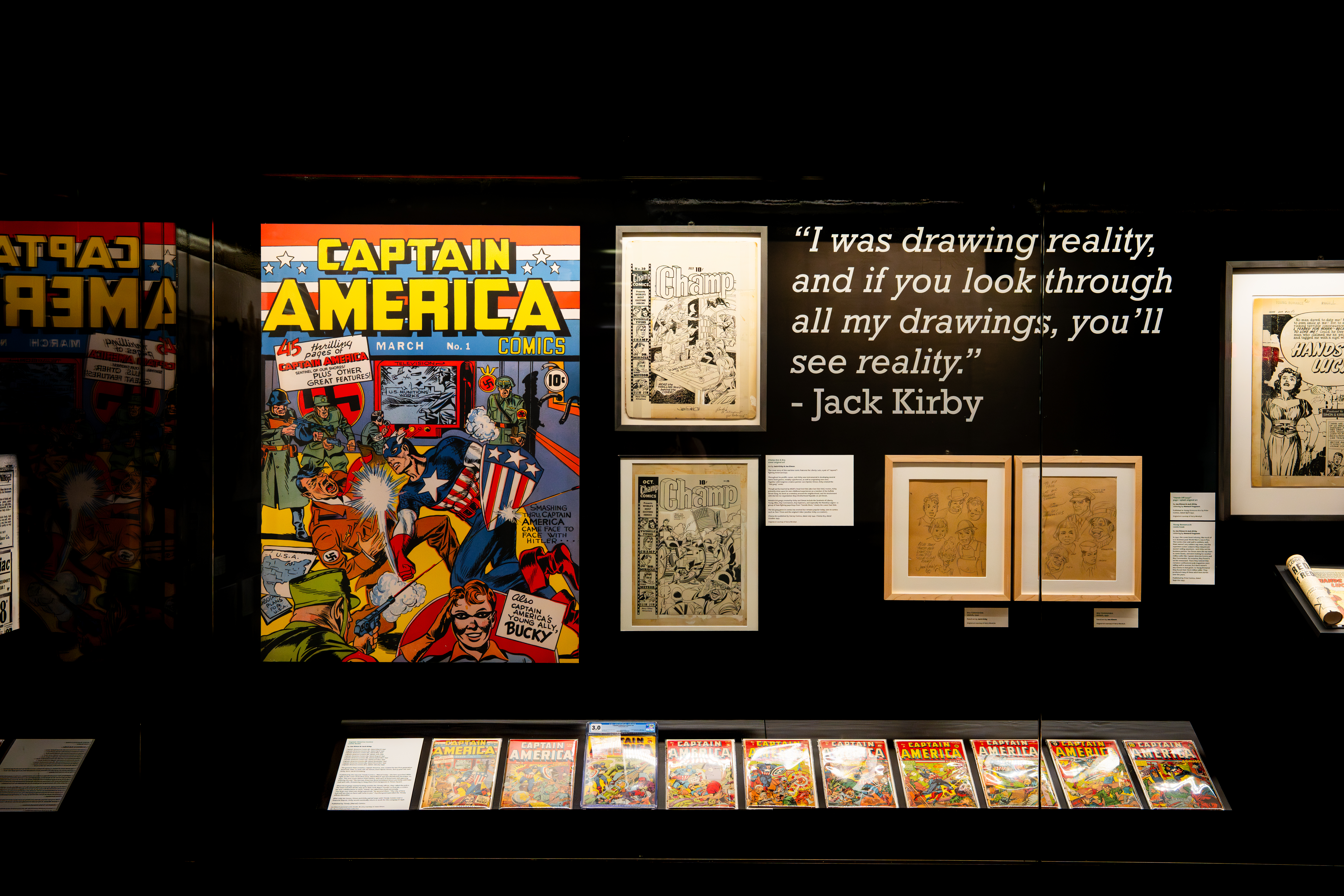
Today the Thing is the most famous Jewish super hero in all of comics (excluding Magneto, who’s still technically a super villain). And the Lower East Side Jewish culture of Kirby’s childhood still echoes in the tone of Marvel comics.
Kirby’s hard-scrabble beginnings on the LES helped fuel his restless energy and experimentation, as well as ground his imagination. His staggering cosmological and metaphysical concepts often combined with the shockingly mundane, which he managed to blend seamlessly. Such was the talent of the “King of Comics.” Fantastic Four #29 is a perfect example.
But—and this was key to earning him the street naming recognition—Kirby’s legacy far exceeds comics and super heroes. His signature style—an ever-evolving fusion of artistic movements ranging from impressionism to cubism to Mesoamerican—and innovation in composition, dynamism and design, can be found today across visual media and art.
He even helped inspire the pop art movement. Richard Hamilton’s 1956 collage, Just what is it that makes today’s homes so different, so appealing?, considered the first significant piece of pop art, features at its center Kirby’s cover for Young Romance #26. Roy Lichtenstein based his 1963 painting Image Duplicator on a panel from Uncanny X-Men #1.
Others who credit Kirby as an influence include film director Guillermo del Toro and authors George R.R. Martin and Michael Chabon.
On July 9, 2025, ahead of the Fantastic Four movie release, Marvel and the City of New York put up a sign on Delancey Street near the corner of Essex, naming it Yancy Street/Jack Kirby Way for the day.
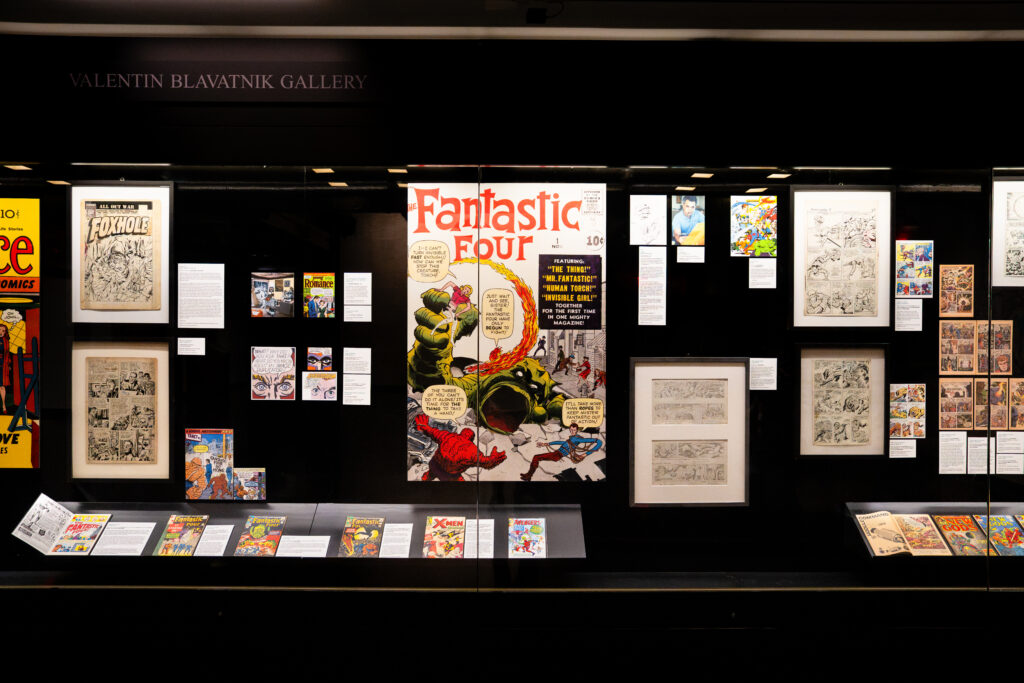
Kirby’s birthplace at 147 Essex is a block up, but he mostly hung out on Delancey, a more major thoroughfare, and it’s Delancey that he immortalized in his comics as Yancy Street. It was the right idea, it just needed a grassroots campaign to make it real.
Kirby depicted the Lower East Side in many of his comics, allegorically and explicitly. Thanks to his stories—now also found in movies, animation, videogames, and elsewhere—children and adults all over the world are familiar with the neighborhood, its history and culture, and particularly Delancey Street. It was only fitting that the neighborhood honor him back.
For nearly a century now, Kirby’s stories and characters have been entertaining and inspiring millions of people of all ages and cultures as symbols of hope, courage, justice and brotherly love.
Jack Kirby is arguably the most important artist in comic-book history. He’s also one of the most important artists of the twentieth century. He’s a founding father of modern popular culture and of a beloved American mythology.
Hopefully, Jack Kirby Way is the first step in recognizing that.
Long live the King!
Roy Schwartz is a board member of the American Jewish Historical Society. He led the campaign to name Essex Street between Delancey and Rivington Streets JACK KIRBY WAY, dedicated on May 11, 2026. Jack Kirby has been his favorite comic-book creator since he was 8.
__________________________________