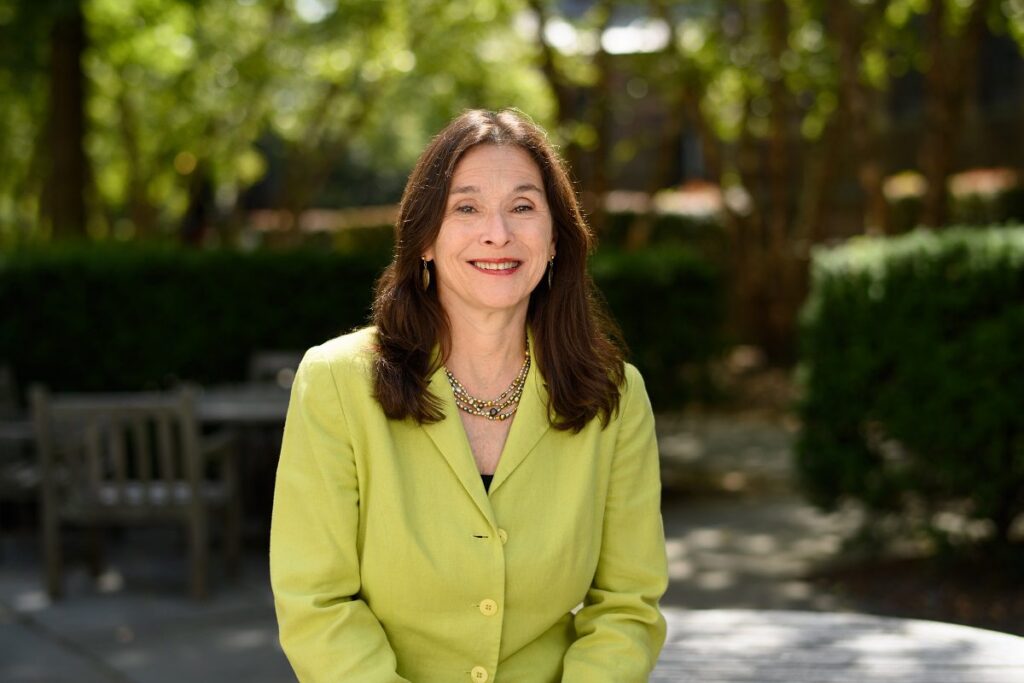
Gemma R. Birnbaum: All We Have Standing Between Us is made possible thanks to the generous support of the Knapp Family Foundation. Additional funding provided by the Leon Levy Foundation, the Achelis and Bodman Foundation, the Atran Foundation, and Anonymous.
Visit the companion exhibition in New York City, on view at the Center for Jewish History July 21st through December 31st, 2026.
Archival Audio – Barack Obama Recites ‘The New Colossus’
One of the largest waves of immigration in our history took place little more than a century ago. At the time, Jewish people were being driven out of Eastern Europe, often escaping to the sounds of gunfire and the light from their villages burning to the ground.
It was at this time that a young woman named Emma Lazarus, whose own family fled persecution from Europe generations earlier, took up the cause of these new immigrants.
She imagined the sight of a giant statue at the entry point of a great nation -– but unlike the great monuments of the past, this would not signal an empire. Instead, it would signal one’s arrival to a place of opportunity and refuge and freedom.
“Here at our sea-washed, sunset gates shall stand,” she wrote,
A mighty woman with a torch…
From her beacon-hand
Glows world-wide welcome…
“Keep, ancient lands, your storied pomp!”…
“Give me your tired, and your poor,
Your huddled masses yearning to breathe free…
Gemma R. Birnbaum: In July 2010, during a rousing speech at American University in Washington, D.C., President Barack Obama reflected on the lessons and legacies of Jewish immigration to America. Invoking the famous words of poet Emma Lazarus, he tied the experiences of nineteenth-century Jewish newcomers to new generations of hopeful immigrants. The story of Jewish immigration, he suggested, represented an important chapter in the continuous quest of new Americans for citizenship and belonging.
Between the 1870s and the 1920s, almost two and a half million Jewish immigrants made their way to American shores. Enticed by economic opportunities and the country’s promise of religious freedom, these Jewish families looked to the United States for refuge. The protective gaze of Lady Liberty seemed a far cry from their difficult lives in Europe, where dwindling jobs, poverty, and a surge in violent pogroms pushed Jews away.
Whether they settled in large and bustling cities like New York and Chicago, or made their homes in small rural towns, the newcomers worked tirelessly to adapt to American life. By overcoming their many tribulations, including workplace inequity, wealth disparity, and shocking acts of antisemitism, they became pioneers, fostering communities and laying the foundations for many of the rights that Americans cherish today.
Welcome to All We Have Standing Between Us. I’m Gemma R. Birnbaum, executive director of the American Jewish Historical Society.
This week’s episode, A Nation of Inconsistencies, begins with an arrival.
Archival Audio – National Park Service’s Ellis Island Documentary
It appeared like in a fog and everybody went over to the railing and just admiring… I thought I was–I thought I was in heaven. My god, is this a city on earth or is this a city in heaven? I’ve never seen a building that big, beautiful. You have to cry.
Esther Schor: Ellis Island opened in 1892, which is a year after immigration was nationalized in the United States. And before its closure in the 50s, it admitted 12 million immigrants.
Gemma R. Birnbaum: Esther Schor is professor of English at Princeton University.
Esther Schor: There was a quarantine when the boat docked near Staten Island, and inspectors boarded the boat. Once it passed, then the first and second class passengers were inspected on the boat. They didn’t have to go into Ellis Island. So when we think of Ellis Island and these crowds of people sort of being herded into pens, these are the steerage passengers. These are the third class passengers.
People were excluded for, like tuberculosis, a venereal disease, trachoma, etc. There was also “X” to suggest insanity or feeble-mindedness. So the idea was to exclude people who were likely to become a public charge, and this was a very important phrase that was used to open the categories of exclusion beyond disease, mental or physical.
You know, if somebody seemed like they had moral turpitude or they were dishonest or they had some kind of criminal background, they could be simply excluded because of the fear that they would become a public charge. So all that said, you know, with 15 to 20% of people sent for further inspection, only 2% were refused entry.
Archival Audio – National Park Service’s Ellis Island Documentary
People were rejected because they showed outward signs of illness, what they considered mental difficulties. We didn’t call it psychiatry, they called it neurology. And we said we’re sorry. And the ship that brought them had to take them back. That was a tragedy…
Gemma R. Birnbaum: The swell of Jewish, Italian, Greek, and Polish immigrants represented a new and dramatic wave of migration from Eastern and Southern Europe.
Daniel Soyer: So why did they come? Because of economic hardship, worsening conditions, a lot of downward mobility.
Gemma R. Birnbaum: Daniel Soyer is professor of history at Fordham University.
Daniel Soyer: They couldn’t get a job. The father lost the business, whatever it was. So people were leaving. And then you have, like, secondary things, I would say. Chain migration. All migration is chain migration, and once people are coming to America, they’re writing back and they’re talking about conditions here, and they’re encouraging people to join them.
Among some young people, there’s a kind of immigration fever or America fever people talk about. So it’s like everyone is leaving, I wanna leave, too.
Gemma R. Birnbaum: For many newcomers, arriving in New York City was overwhelming.
Daniel Soyer: Some of them came from bigger cities, but most of them came from small towns. And it’s New York City, you know, it’s very overwhelming. But once they find their way to the immigrant neighborhoods, and once they find their way maybe to their families even once they start settling in, I think they feel mostly at home.
But even then, there’s kind of a bifurcation, right? So there’s, in Yiddish, people would refer to the alte heim, the old home, and the nye heim, the new home. And so you had these two kinds of homes which were maybe competing for where people felt most at home, and maybe one would come up at more to the fore in one situation, and maybe the other would come to the fore in another situation.
Gemma R. Birnbaum: Divisions between so-called “uptown Jews,” consisting mainly of earlier generations of German Jewish immigrants, and the Yiddish-speaking “downtown Jews” of New York’s Lower East Side were stark and sometimes challenging.
Esther Schor: These people were different. They were different from the Jews who were already here. They came from shtetls and settled in urban areas. So there was this immediate change from living village life to living in a crowded tenement, many of them with unsanitary conditions. Many to a room.
In general, they had no secular education, and of course, there were different degrees of education for men and for women, and they were much more immersed in religious observance than, I would say, the average Jew who was already here in 1880.
So Americans had choices to make. They both had a sense of obligation, but a fear about the consequences of this. So the sense of obligation to fellow Jews, sometimes this was enacted through philanthropy, wealthy German Jews such as Jacob Schiff and Straus, and many others.
Gemma R. Birnbaum: As Eastern European Jewish immigration escalated, several prominent and wealthy Jews of German descent aided the newcomers in their integration. Families such as the Schiffs and the Strauses funded and promoted Americanization initiatives, helping the new immigrants adjust to their surroundings and the American way of life. Among these philanthropists was the Sephardic Jewish poet Emma Lazarus.
Esther Schor: She taught English, she helped them get job placements, she raised awareness, but she also raised money. And she started a group called The Society for the Colonization and Improvement of Eastern European Jews, and went to England to raise money there among wealthy Jews. Now, she was asked in 1883 by people who knew about her work with immigrants to write a poem that would be auctioned off to raise money for the pedestal of the Statue of Liberty, which was in pieces in a warehouse.
Gemma R. Birnbaum: At the time that Lazarus wrote what would become “The New Colossus,” she had never seen the statue.
Esther Schor: It was a work of a bold imagination, and the poem begins by rejecting the classical tradition by the values of military heroism, masculinity, and instead it values Chesed, loving kindness, and the welcome that the statue offers.
Gemma R. Birnbaum: Though Lazarus’ poetic embrace of the “poor, huddled masses yearning to breathe free” has become an iconic American phrase, the poem was largely overlooked by her contemporaries. These towering words were only added to the interior of the statue’s pedestal in 1903, seventeen years after her death at the age of 38.
Archival Audio – William Jennings Bryan’s “Cross of Gold” Speech
Having behind us the producing masses of this nation and the world, supported by the commercial interests, the laboring interests, and the toilers everywhere, we will answer their demand for a gold standard by saying to them, you shall not press down upon the brow of labor this crown of thorns. You shall not crucify mankind upon a cross of gold.
Gemma R. Birnbaum: Beginning in the 1870s, Americans witnessed rapid changes to their society. In addition to scores of new Jewish and Catholic immigrants, the country’s shift from agrarianism into urban industrialization spawned new tensions and deep differences across class, racial, and ethnic lines. Noting the era’s political corruption and severe inequality, humorist Mark Twain dubbed it ‘the Gilded Age.’ As society became rife with inequities, some politicians scapegoated Jews.
Esther Schor: So, antisemitism, as in Europe, has a lot to do with very traditional entrenched tropes of Jewish conspiracies, Jewish people running countries, running the banks, and having power, kind of, you know, cult of Jewish power, some of which is just invisible, but you kind of know it’s there.
There was, especially among populist politicians, with William Jennings Bryan having given the speech called the Cross of Gold speech in 1896 when he was at the Democratic Convention running for president. He opposed the gold standard, with the suggestion that this was a world controlled by Jews.
Daniel Soyer: There are also cartoons which just show that people thought that maybe the Jews were kind of taking over, right?
There’ll be, like, illustrations of New York, and every sign on every building is a Jewish name, and everyone walking down the street is a cartoonish, stereotypical, you know, Jew. And it shows that this was kind of early iteration of replacement theory. That some Americans felt that they were being replaced by this influx of newcomers, and that things would change, and they didn’t want it to change.
Gemma R. Birnbaum: With antisemitism and economic anxiety increasing, some provocateurs attempted to create rifts within the Jewish community. Instead, Jews largely unified and became essential voices in the fledgling labor movement.
Esther Schor: There was much more solidarity than had been anticipated between wealthy and poor Jews. Now, we can also talk about organized labor as a response to wealth disparities and the exploitation of labor and child labor. That was another issue. The Haymarket Affair was May 4th, 1886, and it was a bombing that took place at a labor demonstration to rally support for an eight-hour workday.
So eight anarchists were charged with the bombing. Seven were sentenced to death, and one of them committed suicide, and one other got a prison term. So this set off a wave of anti-radical, anti-immigrant, and anti-Jewish sentiment, propaganda, action. And the word anarchists came to have a very broad brush, you know, was to paint with a broad brush.
So the Haymarket Affair, in a word, was a catalyst for the Jewish labor movement. And the trial of the Haymarket Eight, as they were called, was a kind of turning point for the Jewish working class. The Chicago Cloak Makers Union emerges from this, a precursor to the International Ladies Garment Workers Union.
Daniel Soyer: The predominantly Jewish unions in the garment industry, these included the International Ladies’ Garment Workers’ Union. This is a union of workers who made ladies’ garments, not necessarily a union of lady workers, although the majority of them were female. And then founded a little bit later, the Amalgamated Clothing Workers actually split off from the older union which was a union of people who made men’s clothing.
So what were some of the tactics? Of course, there were strikes. Most notably, there was a wave of strikes, 1909, 1910, famous uprising of the 20,000. This was shirt waist makers. This was a kind of blouse that was very popular and in style at the time, women’s blouse.
And, about 20,000 workers, most of them Jews, many of them also Italian, went on strike at the end of 1909 into 1910.
Gemma R. Birnbaum: The Jewish labor movement wasn’t just unions and strike waves.
Daniel Soyer: It had a much broader meaning. So for example, there were fraternal organizations, most notably the Arbeiter Ring, the Workmen’s Circle, which still exists today. It’s called now the Workers Circle. But this had tens of thousands of members and it provided material benefits, that is, you know, sick care, unemployment kind of benefits, all kinds of help in times of need.
Archival Audio – WPA Radio Play of Triangle Shirtwaist Factory Fire
From March 20th to March 26th, this was news! New York City, March 25th, 1911. On the eighth, ninth and tenth floors of a building at the northwest corner of Washington and Greene streets, over 200 people, mostly girls, employed by the Triangle Waist Company, went to work today, it was just five minutes before quitting time…
Daniel Soyer: The Triangle Factory was actually a big factory. It had 500 workers, which for the garment industry was humongous. You know, not compared to like a Ford factory or something like that, but for New York, and for the garment industry, this was a very large, large factory.
Doors were locked to keep people from leaving. Things were arranged to make it hard for people to leave without having their bags checked so the workers would not pilfer things, pilfer material or whatever from the factory. Fire broke out. It’s not exactly clear how. Probably someone threw a cigarette into a dustbin.
Archival Audio – WPA Radio Play of Triangle Shirtwaist Factory Fire
What’s that? What? I smell smoke! Get out, get out! Get to the roof.
Within thirty seconds after the fire, this fireproof building is a blazing inferno. Girls rush madly about in a frenzy of terror.
I’ll be back for the rest of you, keep your heads!
Daniel Soyer: The fire escapes collapsed under the weight. People started jumping to escape the fire. Some people, of course, did escape over the roofs or before these escape routes collapsed. Fire hoses didn’t work. 146 workers were killed. 70% of them were Jewish. The rest were Italian except for one Jamaican woman. And out of this comes, a wave of reforms, a wave of regulation of factories. People like Frances Perkins, who later became the first woman, Cabinet Secretary, Secretary of Labor under Franklin Roosevelt later on.
And, some, also some of the Jewish, reformers like Belle Moskowitz and Rose Pesotta, who was involved in the labor movement, Rose Schneiderman, they lobby some of the local politicians like Al Smith, who was the Speaker of the New York State Assembly, and Robert F. Wagner, who was a leader in the State Senate. And these guys represent these neighborhoods. These guys come straight out of Tammany Hall. And here these women reformers are talking to them, people that normally they wouldn’t talk to each other, right? And they’d be opponents. But Smith and Wagner were very affected by this as well, and they teach these reformers how to lobby and how to be effective politically.
Gemma R. Birnbaum: An ocean away across the Atlantic, the great powers of Europe clashed in what would become the deadliest global war of its time. By April 1917, America joined the ongoing fight against the Central Powers of World War I.
Most American Jews championed the war effort wholeheartedly. Driven by a sense of patriotism, and hoping to prove their loyalty after years of rising antisemitism, over 250,000 took up arms.
Daniel Soyer: I think that World War I is a bigger turning point in world Jewish history, but also American Jewish history than people realize. It’s eclipsed, of course, by the Holocaust and World War II, but it was a big, important event. First of all, it was a huge disaster for the Jews in East Central and Eastern Europe.
The war is fought there and armies are marching back and forth through these areas of very dense Jewish settlement. And often they’re taking things out on the Jews, not always, but there’s a lot of anti-Jewish violence. American Jews are relatively safe and relatively prosperous, and so they start, in a big way, raising money for their families, their friends, their compatriots in the old home, and especially in their hometowns.
The Landsmanshaftn, the hometown societies, raise a lot of money for their hometowns. You see the founding of community-wide organizations like the American Jewish Joint Distribution Committee, which still exists. And so American Jewry takes on this role of material support for poor Jewish communities, elsewhere, in this case mostly in Eastern Europe, right?
But again, this brings home to them how much they have changed. Their experiences are now different. They’re relatively safe, they’re relatively prosperous, and they are thinking also in slightly different ways, a very kind of more modern American bureaucratic ways.
Gemma R. Birnbaum: By the 1920s, the Jewish immigrant class that had radically transformed American labor, and dedicated its resources to a war of unprecedented scale, faced new barriers to building their communities. Nativist politicians who had long protested American Jewry’s expansion had managed to pass the Johnson-Reed Act, effectively ending the age of immigration. For a time, the country would fall short of fulfilling the ideals Emma Lazarus once imagined…
Archival Audio – Barack Obama Recites ‘The New Colossus’
Send these, the homeless, tempest-tossed to me,
I lift my lamp beside the golden door!”
Let us remember these words. For it falls on each generation to ensure that that lamp -– that beacon -– continues to shine as a source of hope around the world, and a source of our prosperity here at home.
Gemma R. Birnbaum: From the American Jewish Historical Society, I’m Gemma R. Birnbaum. This episode was written by Andrew Sperling. Recording, sound design, and mixing were done at Sound Lounge. Archival material is from the AJHS collections, the National Park Service, the Library of Congress, and WNYC Archives.
For episode transcripts, additional resources, and links to the collections discussed in this episode, visit ajhs.org/democracy. If you enjoyed this episode, please rate and review us on your preferred podcast platform which helps others discover our series.