Megan Scauri, Senior Librarian, AJHS: The World in Front of Me is presented by Jay and Gretchen Stein, with generous support from the Knapp Family Foundation, the Philip and Muriel Berman Foundation in Honor of Alan Bloch, Scott and Dianne Einhorn, The Karetsky Family, and Michael Koss.
In NYC? Visit the companion exhibition on view at the Center for Jewish History, now through May 2026.
Ruth Ellenson: When people ask you where you’re from, do you say Los Angeles now? Do you think of it as your hometown?
Bill Aron: Yes, definitely.
Ruth Ellenson: What does it mean to you to be an Angeleno?
Bill Aron: (Laughs) Let’s see. When we—in 1978, when we drove out here, Isa and I joked among ourselves. Where are you from? “Oh, I’m from California.” There’s a certain panache.
Host Ruth Ellenson: That’s Bill Aron, prolific photographer of Jewish life. I’m your host, writer Ruth Andrew Ellenson. I was fortunate to grow up being photographed by Bill, and welcomed the opportunity as an adult and a journalist to explore the legacy of his work, and the context in which it was created. Over the course of our series, we’ll travel with Bill across five decades, and hear his stories about documenting Jewish communities around the world.
From The American Jewish Historical Society, welcome to The World In Front of Me with Bill Aron. This is episode 9: Los Angeles.
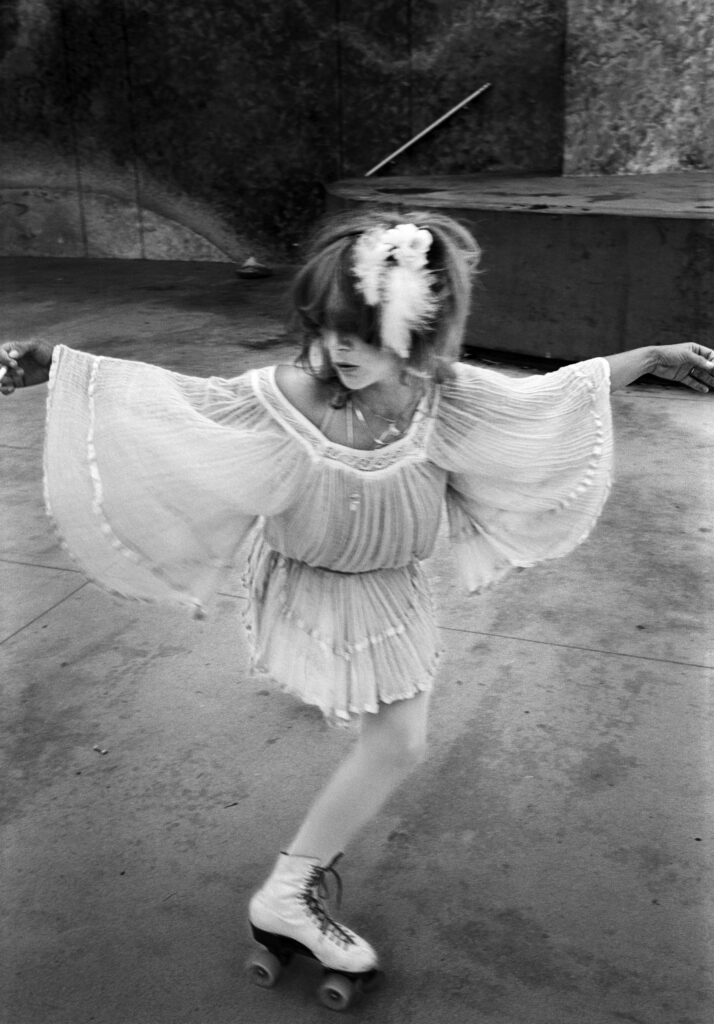
In 1978, Bill and his wife Isa left New York City for Los Angeles. Initially settling in the countercultural swirl of Venice Beach, Bill documented the street performers, body builders, roller skaters and the elderly population he found there. The energy of California proved transformative for him as a photographer. In the 1980s, Bill and Isa found their permanent home in the vibrant Jewish community of Pico Robertson where they raised their sons Hillel and Jesse–both LA natives.
Bill focused on documenting the Jewish community that informed his daily life in Los Angeles, while also lending his talents to causes in the larger Jewish world, such as Soviet Jewry and supporting the work of United Jewish Appeal. Many of those Los Angeles photographs became defining images of modern Jewish life, and can be found on everything from billboards to the walls of museums.
Ruth Ellenson: Although I met you in New York as a two-year-old with a lot of self-confidence, apparently (laughs), and a community that, luckily for me, encouraged that. When I think of you, I think of my life growing up in Los Angeles, and you are very much intertwined in my mind in that place.
So one of my first memories of you in Los Angeles is visiting you in Venice Beach, and you taking me roller skating. And in fact, there is a picture of me tying on roller skates, wearing a straw hat.
Bill Aron: One of my favorite pictures of you. I love it.
Ruth Ellenson: Can you tell me a little bit about how you and Isa decided to live in Venice Beach, and how you came to photograph life on the boardwalk there?
Bill Aron: We were faced with the prospect of moving to Los Angeles at a time when my career as a photographer was just beginning to take off, you might say. There was a clear decision. Because we moved to Los Angeles for Isa’s career, I got to pick where we lived.
Ruth Ellenson: That is a good compromise in marriage, an example to all of us, and how you two have probably stayed married now fifty-two years. Is that right?
Bill Aron: We were married in ’73, so it’s fifty-two, yeah.
Ruth Ellenson: You were moving for Isa’s job, and then you got to pick the neighborhood that you lived in. Why did you choose Venice Beach?
Bill Aron: It seemed a really cool place, and going around and—you know, running around the city, and looking for where we should live. I did not consider where the Jews are or where they aren’t or anything. I wanted to live near the ocean. And Venice was still kind of undiscovered in 1978, and places were more affordable. And so we rented this nice little bungalow about—between a half a mile or a mile from the beach, with a clear walk through the canals. You know, there are canals in Venice, so a clear walk through the canals to the ocean. And I loved it there.
Ruth Ellenson: What was the neighborhood like?
Bill Aron: Grungy is the best word. It hadn’t yet gentrified as it has now. It was like the closest thing to a working-class neighborhood that you could find. We lived at the end of a cul-de-sac, and next door to us lived an artist. Next to him lived a retired—some kind of laborer down the street, was this wonderful Latino family that made the best tacos I’ve ever tasted. So, it was like being on vacation because I hadn’t established myself as a working photographer. And I was still in the idea that I want to photograph everything that moves me. And I discovered the roller skaters who were out there, especially on the weekends. But every day of the week. I took some pictures there, and I was very unhappy, so I sent them to Howard Becker, who was a sociologist who, among other things, studied and wrote about the sociology of art and was kind of a mentor to me.
And he said—and he says, “Well, you’re photographing them just the way you photograph the elderly Jews on the Lower East Side of New York.” He says, “You have to do something. Close your eyes, lie on the ground, just do something different. Don’t look photograph behind you, with not looking at what you were doing.” And so I did that, and I found—I didn’t do anything that lasted, but I discovered a kind of energy that I felt while I was watching and interacting with these roller skaters. Eugene Smith was a photographer who put a lot of emotion into his photographs, and looking at his work taught me that you could really capture an energy, capture an emotion in your photography, and that’s what I was looking for. And I just would go back there every day, and I was taking care of our son, too, who was in a stroller. Hillel was one year old, and I would just put him in the stroller, go down, and we became well known among the roller skaters, who allowed me to photograph them from any angle, doing whatever I wanted. And they all would come over and play with Hillel and, you know, try and talk to him—or he wasn’t talking those days. (laughs)
Ruth Ellenson: You found real freedom in moving to California.
Bill Aron: I did. I was no longer—you know, the Havurah and the Lower East Side as an old immigrant Jewish community, they kind of anchored me, and they formed a structure around my life, and there was very little opportunity to go outside. And I never sought to go outside.
I think getting out of New York was very healthy for me. The last show I had in New York was in New York City, as opposed to the Pucker Gallery. I mean, I think without the Pucker Gallery taking me on, my career would have been very different because having gallery representation was and is an important milestone of someone developing a career in a particular field.
And coming out to L.A., my first show was at the Skirball Museum. Although it really was national, it felt local. It’s just the idea that you’re not on a world stage was, I think, for me, a healthy thing.
Ruth Ellenson: And allowed you to be more open in how you approached your work?
Bill Aron: I think more open, more experimental, not so ambitious for the final product but to dwell on the making of the product. Garry Winogrand said it best. He said, “You know, if all you care about is showing your work or exhibiting your work, or having it published, and you don’t get that, you’re left with nothing, but if you like what you’re doing, whether or not it gets to that end doesn’t matter. You’ve had the experience of being totally involved and in love with your work.”
Ruth Ellenson: Did you begin photographing Jewish subjects in Los Angeles?
Bill Aron: I did. I received a commission from Nancy Berman, who is the director of the Skirball Museum in Los Angeles. She wanted to exhibit a painter who painted abstractions of the elderly Jewish population in Venice, people who went to the Israel Levin Senior Citizen Center.
Ruth Ellenson: Was there a particular demographic? Were these people who come from New York? Were they Holocaust survivors? Who were the type of people who made up that community?
Bill Aron: Any and all. They were just people who frequented—the seniors—were old enough to identify with and frequent a senior citizen center.
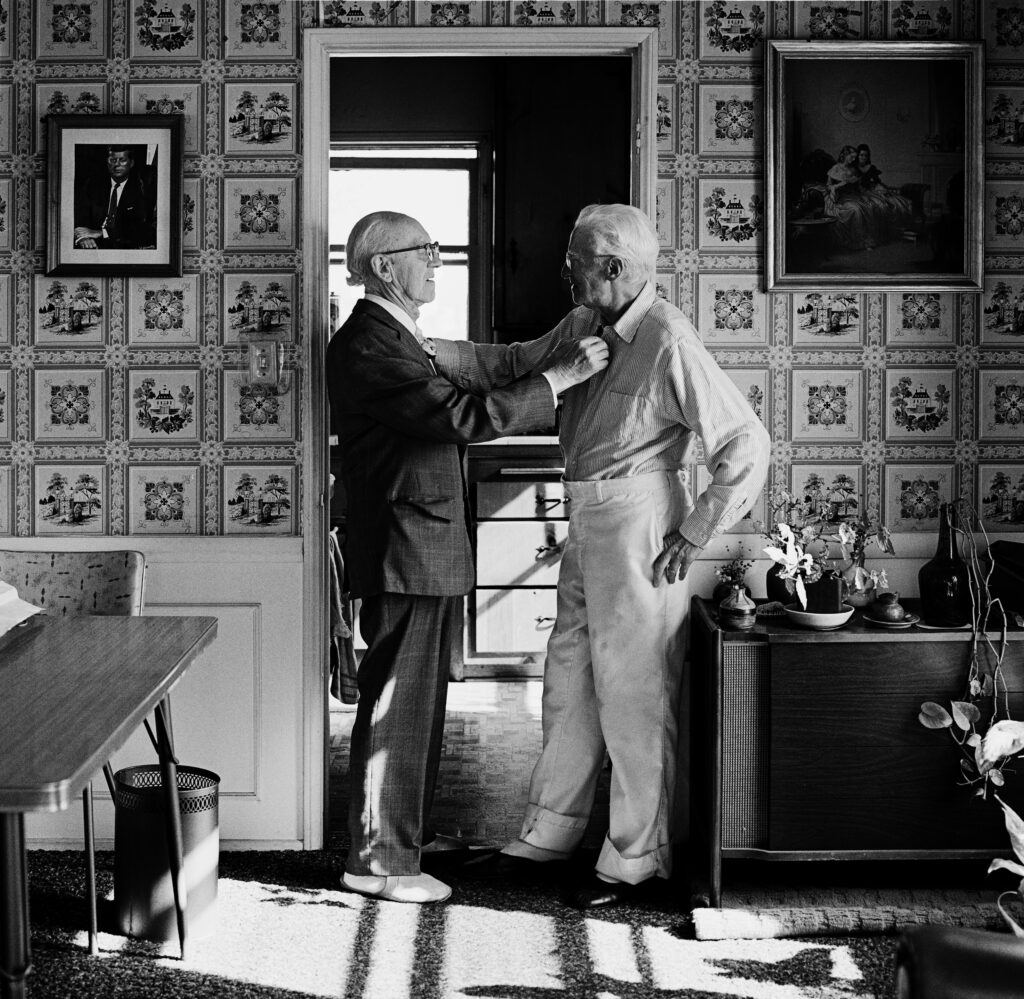
I think it was the first time where I was able to focus solely on portraiture and arranging the scene. Didn’t always do it so creatively, but—you know—it was 1978, ‘79, ’80. And I’d only been doing it, five years. It was also an important learning experience for me. And there are some of those portraits that I’m quite proud of. I was photographing not only the people in a way that I found interesting but also in their environments.
Ruth Ellenson: Tell me when you felt like you had gained some entry and were photographing it or exploring it through your photography?
Bill Aron: I made contact at the Jewish Federation. I met Barbara Chmelar, she hired photographers to cover events that the Federation was having. So we became friends, and she began hiring me. And I, at that point, began to identify with and become known in the Jewish community here.
Ruth Ellenson: I mean, I think of so many pictures you took at various events. In fact, this was a recent thing for me. There was a photograph you took of my family of origin—my father, my mother, my brother. And my father and my brother have since passed away. And I think it’s the only photograph I have of the four of us as a family. They got divorced, I think, months afterwards.
Bill Aron: Yeah.
Ruth Ellenson: And it was very powerful to see that. And I think about all of the families and Jewish moments you documented in Los Angeles that showed up in everything from Federation materials to different types of Jewish images that were utilized for a variety of things. Did that body of work have the widest reach in terms of how it was utilized?
Bill Aron: Most likely, because L.A. is a big place. And if you did a photograph that starts appearing on a billboard, then a lot of people see it because we’re all in our cars a lot of the time.
I think also what helped was the work I did in the former Soviet Union. That was used for—extensively—in the Soviet Jewry movement, and also appeared on, not billboards but appeared on posters in different places, at rallies.
Ruth Ellenson: A lot of the photography you did in Los Angeles focuses on families, family moments, the photograph I was describing of my family that you took. You also photographed your own family. When you think of your photography in Los Angeles, does that become one of the themes for you or a way in which you featured Jewish life?
Bill Aron: It’s an interesting question. There’s my family life in L.A., which I considered sort of a personal life. And then there were projects that I did or commercial work that I did to illustrate brochures and things. And I don’t think of my personal, family photography as part of Jewish life; although I guess it could be in retrospect.
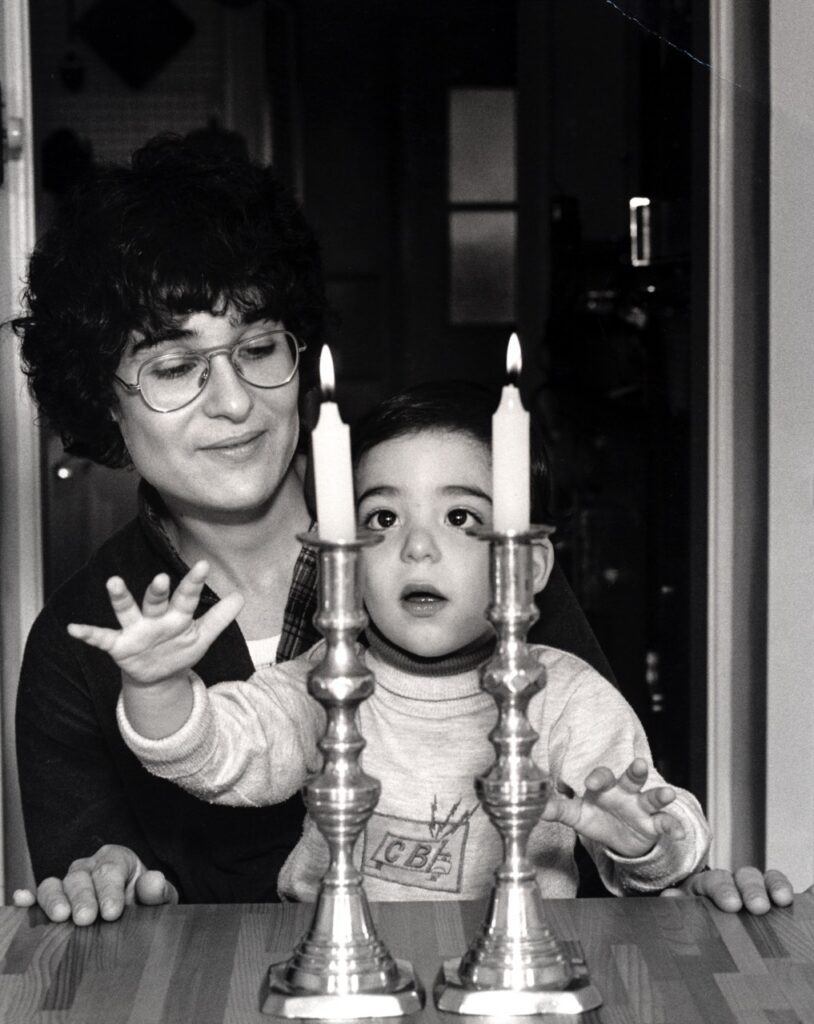
Ruth Ellenson: That’s interesting because when I think of a lot of the images you took in Los Angeles of my family or other families and your family, your sons, I think of how widely those were seen within the Jewish world. So it’s interesting to me that you talk about that as a project that’s separate. I’m thinking in particular of two photographs you have of your sons, Hillel and Jesse, when they’re very little in Los Angeles, and one is of Hillel lighting Shabbat candles with Isa, your wife, their mother, and another one is of Jesse holding a challah at a Jewish bakery, where his cheeks are as round as the challah he’s holding. But do you think of those more as personal photographs as opposed to Jewish ones, per se?
Bill Aron: I guess when you put it in that context, yes, they’re part of my Jewish photography, but I’m not used to thinking of them as part of—as part of my wider body of work, although certain of the images clearly are. I mean, I like that picture of Hillel and the Shabbat candles and Jesse in the bakery with me because, before and after, he was stuffing his face with sprinkle cookies to get him to sit still. (laughter)
Ruth Ellenson: You had to bribe with cookies in order to get the challah shot, ok got it.
Bill Aron: Right, Deborah Lipstadt was with me then, and she helped out by handing him cookies. (laughs)
Ruth Ellenson: It’s dangerous to work with, what, children and animals. (laughs)
Bill Aron: Right.
Ruth Ellenson: Both respond to bribery.
It is genuinely surprising to me to hear that you do not consider that part of your Jewish photography, per se, because in particular, I’m thinking about the Skirball Museum in Los Angeles, in which I think practically every photograph in the permanent exhibition is one that you took of Jewish life. And if I’m recalling correctly, the majority of those photographs are in Los Angeles.
Bill Aron: What it makes me think is that because of the way my career turned into thinking of my work as project-oriented, these were more photographs that I took along the way, in between my project, maybe even while I was in a project doing something else. So I think that’s why I’m having a hard time considering them part of my canon, so to speak.
Ruth Ellenson: When I think of photographs you’ve taken over the years, the ones I’ve seen utilized most widely or have come up in different ways, they’re all from family life cycle moments in Los Angeles—my family, other families. And the fact that they are all over the Skirball Museum in Los Angeles, which you could argue as one of the leading Jewish museums in the world. So it’s fascinating to me to see the bifurcation of that for you. And I love the fact that they were just sort of photographs of your life as a Jewish person in L.A. that ended up in all of these different places.
Bill Aron: Uh-huh (affirmative). Okay, I will rethink that. Thank you. (laughter)
Ruth Ellenson: There is a picture from my bat mitzvah where I have extremely unfortunate 1980s hair, which I believe I’d poured a bottle of Sun-In on at Camp Ramah. And I’m wearing the biggest shoulder pads possible. I, of course, thought I looked extremely cool. There’s a picture from my bat mitzvah of me reading Torah, and I saw that photograph blown up. It was probably, like, five feet wide. (laughs) And so perhaps I’m keenly aware of those photographs coming up. When I think about your work in my life, a lot of those were just organic moments of you photographing your life and world in Los Angeles, which was clearly very Jewishly focused and has become universal in how Jews are seen in various ways.
Bill Aron: Thank you, you really make me see some of my work in a very different light.
Ruth Ellenson: Bill, it has been an honor and a joy to talk to you about your amazing career and your body of work. And I, again, feel so lucky to have grown up with you and in front of your lens and the opportunity with this podcast, to learn more about your life behind it. We are all very fortunate to have you and your photography in our world. And I think especially the Jewish world in particular has a lens of itself reflected through your body of work that is unique. So thank you for talking to me about it.
Bill Aron: I want to thank you, Ruthie, for doing this. I have learned so much by your questions, and I’m only sorry it’s over.
Audio: DSLR camera shutter and click.
Host Ruth Ellenson: Stay subscribed to The World in Front of Me for bonus content and more stories from the archives. And join AJHS in July 2026 for All We Have Standing Between Us, a new podcast series exploring 250 years of American Jews and their role in shaping American democracy.
But for now, this is where I leave you. One final time, from the American Jewish Historical Society, I’m Ruth Andrew Ellenson.
This episode was written by Rebeca Miller and produced by Sarah Hopley. Our executive producer is Gemma R. Birnbaum. Recording, sound design, and mixing were done at Sound Lounge and Studio Awesome.
For episode transcripts, additional resources, and links to a selection of Bill’s photographs that inspired this episode, please visit ajhs.org/bill. If you enjoyed this episode, please rate and review us, which helps others discover our series. Thanks for listening.