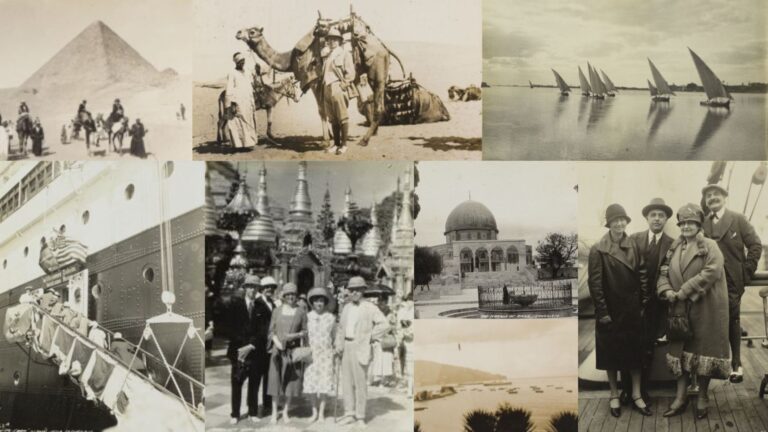
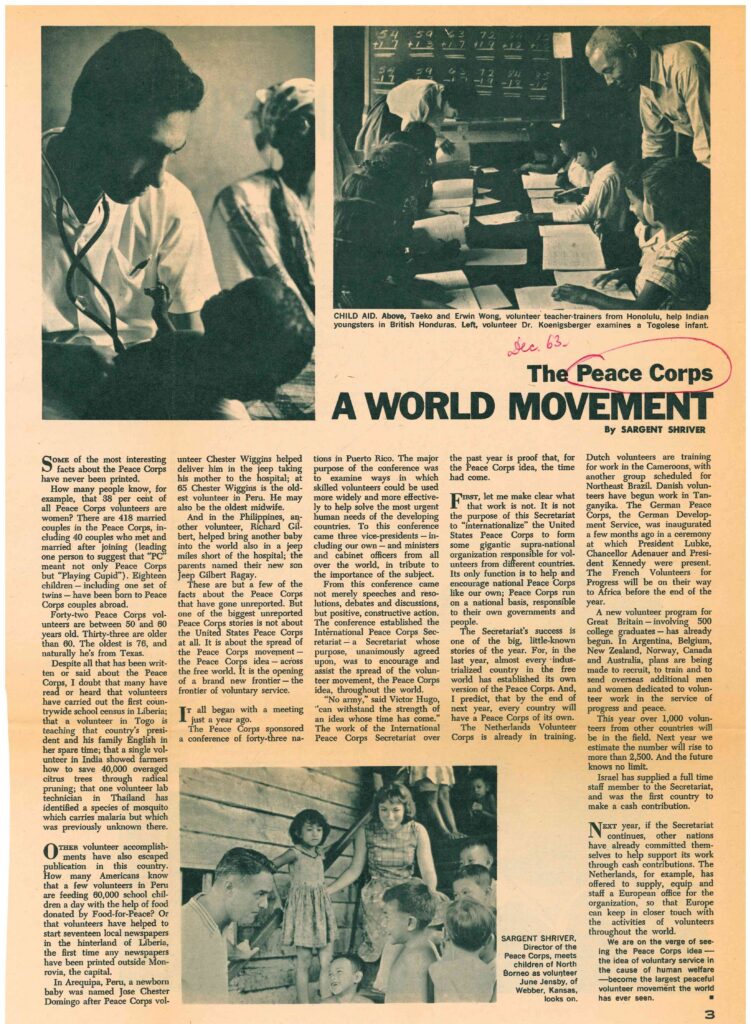
Sixty-four years ago, on March 1, 1961, the United States Peace Corps was born. The first public inklings of the Peace Corps began at a speech given by then presidential candidate, John F. Kennedy, Jr. on October 14, 1960. Kennedy, during a 2:00 a.m. campaign stop at the University of Michigan, stood amid hundreds of students and asked those gathered: “How many of you, who are going to be doctors, are willing to spend your days in Ghana? Technicians or engineers, how many of you are willing to work in the Foreign Service and spend your lives traveling around the world?” A few weeks later at a campaign stop at the Cow Palace in San Francisco on November 2, he proposed ‘a peace corps of talented men and women’ who would dedicate themselves to the progress and peace of developing countries. Encouraged by more than 25,000 letters responding to his call, Kennedy took immediate action as president to make the campaign promise a reality.”
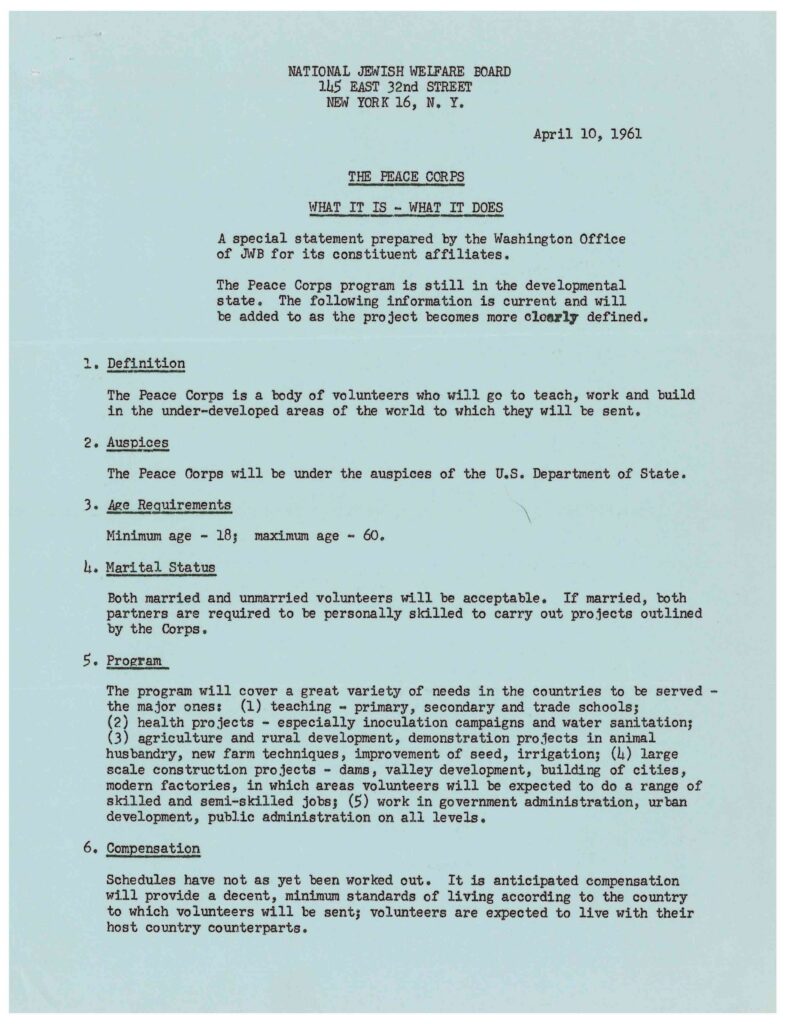
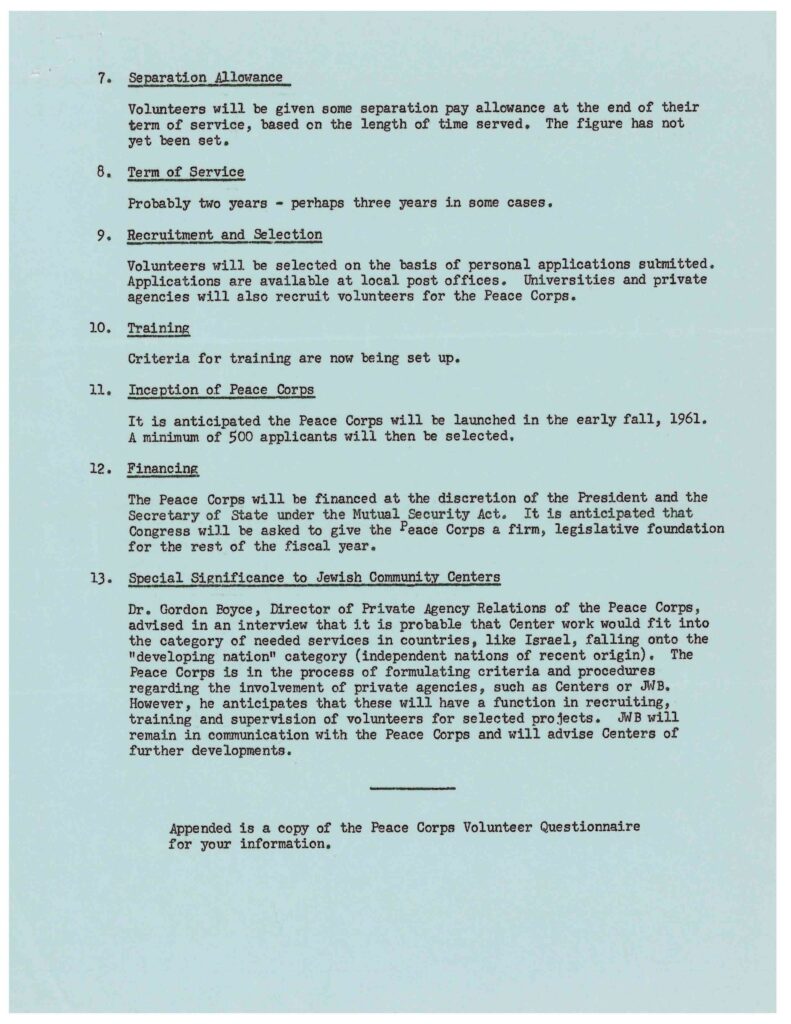
National Jewish Welfare Board: The Peace Corps, What It is–What It Does. NJWB Records. Box 599, Folder 2.
President Kennedy was not the first person to propose a Peace Corps made up of young Americans to fulfill humanitarian and developmental objectives. In fact, it was Walter Reuther, president of the United Auto Workers, who first proposed a vehicle in 1950 for young Americans “to join with other young people in the world to be sent abroad with slide rule, textbook, and medical kit to help people help themselves with the tools of peace, [then] the fewer young people will need to be sent with guns and weapons of war.” In 1956, President Eisenhower called for the creation of the People-to-People Student Ambassadorship program, which sought Americans for exchange experiences with primarily European countries. Its first program started in 1962. However, it was a Black clergyman by the name of James Herman Robinson who first put the idea into actual practice by creating the Operation Crossroads Africa (OCA) program in 1958 that connected Americans with African countries to help build infrastructure and improve education.
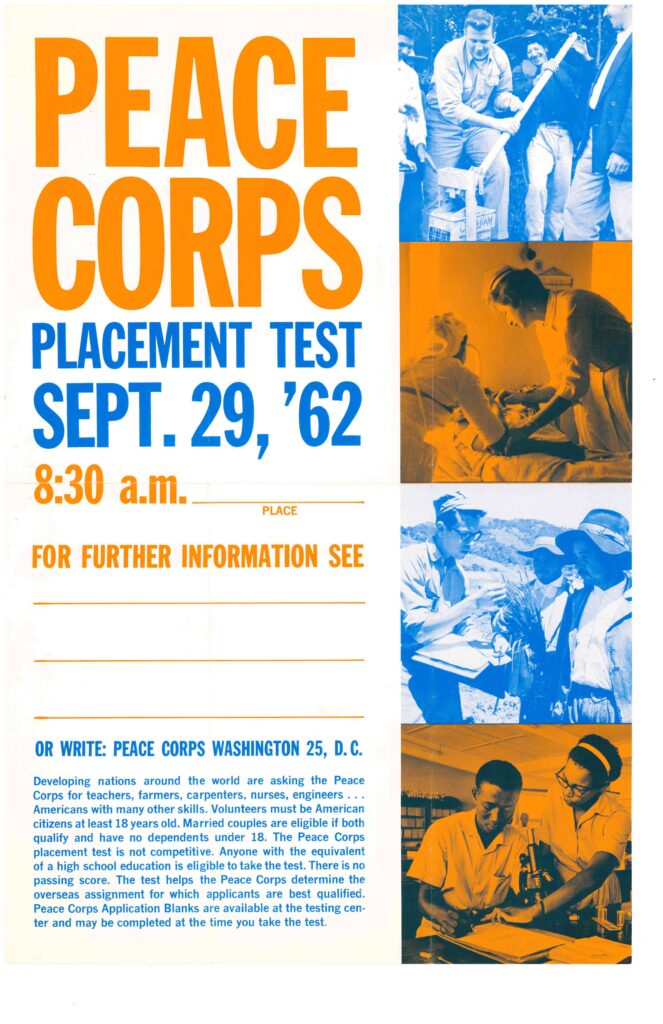
In August of 1960, Reuther met with Kennedy to talk over the upcoming November 1960 election. Reuther proposed the Peace Corps model to Kennedy that Kennedy would later speak on at the University of Michigan the following October and November. From 1950 to 1961, the foundations of a Peace Corps developed until President Kennedy won the presidency and put the model into action, appointing his brother-in-law, Sargeant Shriver as its first director. In 1962, the first groups of young Americans went forth to Ghana and Tanganyika (currently Tanzania) as the first volunteers.
The collections of the American Jewish Historical Society contain a surprisingly wide variety of information on the Peace Corps through its sixty-four-year history including original descriptions of countries where Peace Corps volunteers traveled, volunteers themselves, and organizations such as the National Jewish Welfare Board, Hadassah, the Women’s Zionist Organization, the Synagogue Council of America, the American Association of Ethiopian Jewry, Representative Nita M. Lowey, and even a brief mention in the Anti-Defamation’s League John Birch Society collection.
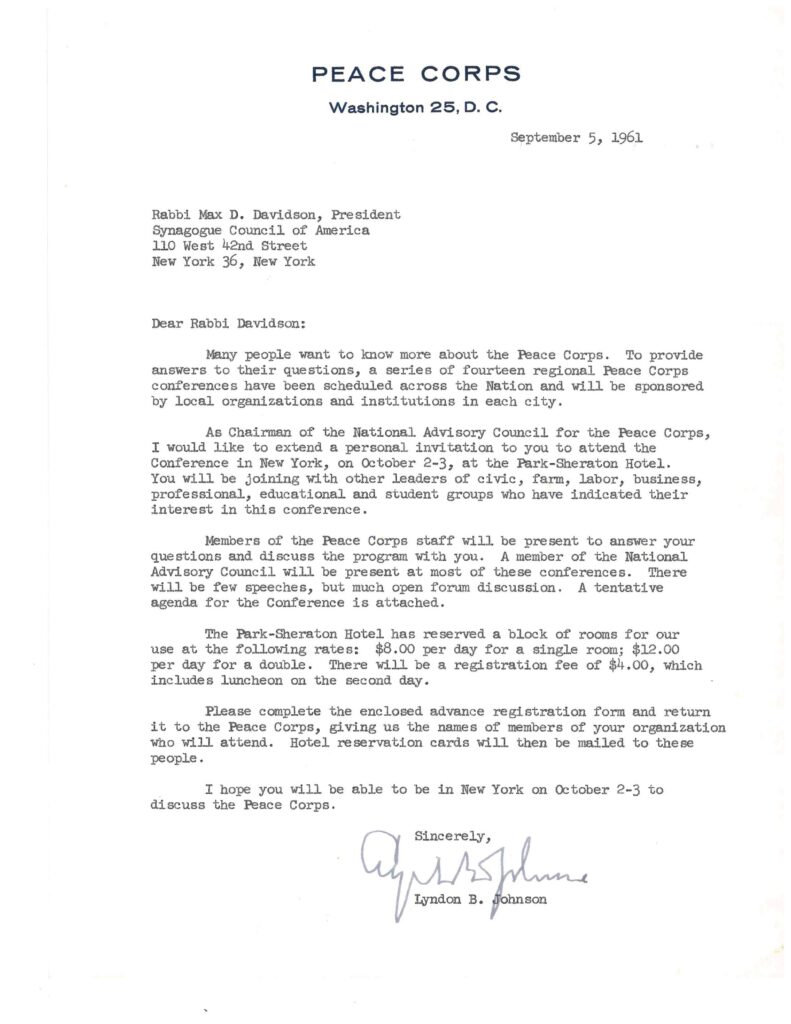
If you’d like to learn more about the Peace Corps connections in the archives of the American Jewish Historical Society, search our collections at here.
Dedicated to my birth parents, Marilyn and Lafayette, who were in the first class of Peace Corps volunteers, and to my parents, Ethel and Edward. May their memories be blessings.
Sources
David Geffen to Rabbi Philip Hiat, 1963. Synagogue Council of America. I-68. Box 30, Folder 2.
John F. Kennedy Presidential Library. “Peace Corps.” November 07, 2024 https://www.jfklibrary.org/learn/about-jfk/jfk-in-history/peace-corps. Accessed February 10, 2026
National Jewish Welfare Board. Subgroup II: Jewish Community Centers; Field Services; Regional Area Offices, Washington, D.C., Box 599, Folder 2: Peace Corps.
Peace Corps, 1961-1964. Hadassah: The Women’s Zionist Organization, I-578/RG 11
Peace Corps Placement Test Poster, 1963. Synagogue Council of America. I-68. Box 50, Folder 4
Representative Nita M. Lowey Papers. Peace Corps-Religious Freedom, 2008-2019. Digital objects. https://archives.cjh.org/repositories/3/archival_objects/1362790
Operation Crossroads Africa. “’Operation Crossroads Africa and the “Progenitors of the Peace Corps.’” https://www.peacecorpsconnect.org/operation-crossroads-africa-and-the-progenitors-of-the-peace-corps/ Accessed February 25, 2026.
Wikipedia. “Peace Corps.” https://en.wikipedia.org/wiki/Peace_Corps. Accessed February 10, 2026
Wikipedia. “People to People Student Ambassador Program.” https://en.wikipedia.org/wiki/People_to_People_Student_Ambassador_Program. Accessed February 4, 2026.