Megan Scauri, Senior Librarian, AJHS: The World in Front of Me is presented by Jay and Gretchen Stein, with generous support from the Knapp Family Foundation, the Philip and Muriel Berman Foundation in Honor of Alan Bloch, Scott and Dianne Einhorn, The Karetsky Family, and Michael and Corie Koss.
In NYC? Visit the companion exhibition on view at the Center for Jewish History, now through May 2026.
Bill Aron: My Jewish experience has indeed been informed by my photography because it’s enabled me to enter all different aspects of Judaism, from Orthodox to assimilated. It’s like trying it on. It’s like trying on a new pair of clothes. And it all came to me and got inside me and mixed around, and came out with what I do—sometimes this way, sometimes that way.
Host Ruth Ellenson: Bill has traveled to Israel numerous times since his first visit as an undergraduate in 1961. In 1980, and again in 2010, he returned, no longer a student, but a professional photographer, seeking to capture everyday life in historic spaces. These images have a clear sense of time and space, and yet somehow look timeless.
Ruth Ellenson: So, I know your junior year of college you spent abroad in Israel. What year was that, and how did you end up going?
Bill Aron: I was sitting in class, Moshe Greenberg’s Hebrew class, and staring out the window, feeling quite alone, quite bored, quite fed up with everything. And the student next to me nudged me with a piece of paper to pass around. I noticed a headline that said, You don’t have to know a foreign language to study abroad. And it was from the American Friends of Hebrew Union University.
Michael Brenner: So for American Jews, Israel, when it was found in 1948, was perceived almost as a miracle as for Jews worldwide. It was only three years after the Holocaust, and to have a Jewish state after almost 2000 years was seen by many as, really rising out of, literally rising out of the ashes of the Holocaust.
Host Ruth Ellenson: That’s Dr. Michael Brenner, Professor of Jewish History and Culture at the University of Munich and the Seymour and Lillian Abensohn Chair of Israel Studies at American University in Washington D.C.
Michael Brenner: So I think we need to understand a particular feeling, combined sometimes with a little bit of bad conscience or at least bad feelings that American Jews couldn’t do more to help Jews in Europe, often their own families, during the Holocaust. So there was now a feeling that, now they can help a Jewish state to exist. But we also should realize that during the 1950s and even 60s, most American Jews did not visit Israel. And their solidarity was also somewhat limited.
American Jews in Israel is really very diverse topic, where you can see on the one hand, idealization, but also willingness to help and support, and sometimes even a bit of a bad conscience of not living there, not moving there themselves.
Bill Aron: And I applied, was accepted, and spent a wonderful year in Israel—a very young Israel, very different from the Israel today.
Ruth Ellenson: Can you describe for us what it was like back then?
Bill Aron: There are two stories that characterize what Israel was like.
One, is I was visiting some people in Haifa. And I left them on Friday afternoon and went out to the bus stop to wait for a bus to go to the central terminal. And I was waiting for a pretty long time. And a gentleman who was passing by stopped his car, came over to me, and said, “Can I help you?” So I said, “Oh, I’m just waiting for the bus.” And he said, Well, the buses have stopped running for Shabbat. So I said, “Oh.” And he said, “Why don’t you come to my house and spend Shabbat with us, and then I’ll take you to the bus station tomorrow?” And he brought me to his home, and it happened to be a night when he was entertaining other people. So, and it was just such a wonderful, warm experience. They fed me. We had a great time during the day, and then he took me to the bus station.
And the other story, we used to hitchhike everywhere. It was with some friends, and we were picked up by this man in a nice, roomy car—there were three of us. And we started to stumble with our Hebrew in having a conversation with the driver. He stopped us, and he spoke in English. He says, I take it you speak English. And I said, “We do.” And it came out in the conversation that we were students at the university. And he stopped, and he said, “Since you’re students at the university, you have to learn Hebrew.” And he switched back to Hebrew and refused to speak English with us.
Ruth Ellenson: Both of those stories feel so profoundly Jewish, like, “Come in, we’ll feed you. We’ll take care of you. You’re a nice boy.” And also, like, “You should try harder. You got a ninety-seven on the test. Where are the other three points?” Right? (laughs)
Bill Aron: I think it also speaks to the—there was a pioneering aspect to early Israel. I mean, Israel was a state—declared a state in 1948. So, this was thirteen years later. And it was young. It was just feeling its oats, so to speak. It was growing. It was establishing a culture. And it was just a wonderful place to be. And it was really, actually, one of the best years of my youth.
Michael Brenner: In 1948, Israel, first of all, was a state at war. It was just established as a result of the United Nations vote of 1947 to establish two states in Palestine, a Jewish and an Arab state. The war ended with an armistice in 1949, and what started then was a mass immigration. Both of Jewish Holocaust survivors from Europe, but also of Jews from Arab countries, Yemeni Jews, Iraqi Jews, and later North African Jews.
So the composition of Israel society changed much. It was the time when the so-called Mizrahi population, Jews of Arab and Muslim countries, increased. And also Israel became a society where the living standard slowly but clearly increased between 1948 and 1961.
Host Ruth Ellenson: Israeli society, and the region, were also greatly impacted by the changes resulting from the 1967 Six-Day War.
Michael Brenner: I would call the Six-Day War, and what resulted out of it a second foundation of Israel, almost the second establishment of the state of Israel. Israel changed tremendously. Israel not only enlarged its territories three times, but it also became an occupational power after 1967 holding territories that until this day are not part of Israel, are not annexed, and where a large population lives that does not want to be under Israel’s rule. But also, one result of the Six-Day War was that Jerusalem was reunited and that Jews, for the first time after almost 20 years, were able to go to the old city of Jerusalem, to the most holy sites of the Jewish people.
There was a feeling of enthusiasm of euphoric, I mean, almost euphoric feeling after the 67 war, that Israel almost had evolved from a David to the Goliath, to a major power in the Middle East.
Ruth Ellenson: So, what was it like when you went back in the eighties as a photographer in a professional capacity?
Bill Aron: It was a busy Israel.
Ruth Ellenson: Just more people, more things going on? What do you mean by busy?
Bill Aron: Well, one aspect was there were a lot of people in the streets. Another aspect was that everyone was involved in their lives. It was much less free time. It seemed to me that people didn’t sit back. They didn’t pick up hitchhikers anymore. We were told not to hitchhike. And it was a more difficult time, probably a presage of things to come.
Ruth Ellenson: Was that the first time you’d been back since college?
Bill Aron: Yeah, I think what had happened in the meantime was I had changed careers from sociology to photography.
I knew that I had to come to terms with creating a portfolio of—from Israel, of photographing in Israel.
I guess a lot of it was establishing myself as a Jewish—quotes around Jewish—photographer who is interested in expressing Jewish themes and photographing and creating moments around being Jewish, that I felt like being in Israel and photographing was not only an extension, but something I had to do.
Michael Brenner: So between 1961 and 1980, Israel changed dramatically. In terms of living standard, Israel became more and more, I would say a western country, even though its population became more and more composed of people whose origins are in the Arab world.
Another change starting in 1977 was that after 30 years of left-wing labor party rule for the first time, the right-wing Likud party came into power in 1977. And besides its political changes, that also meant some economic changes. Israel became more of a capitalist society. The gap between rich and poor was slowly growing and I would say many of the ideals of the old Israel, of the 1950s and sixties changed more of almost a modern western capitalist society.
Ruth Ellenson: So, did you go in, as you returned to Israel as an adult, as a photographer who has a body of work you’re creating? Did you come in with an agenda of things you wanted to photograph, or was it more organic—walking around and seeing what you encountered?
Bill Aron: No, I was really—I was really open. It was an exploration in the same way. All my work is—most of my work has been—it was an exploration of what I would find.
I lived in dread of the harsh light that I would find in Israel, but in fact, I found it to be a blessing because it enabled me to focus more on the geometry of what I was finding in the landscape.
Ruth Ellenson: So what were examples of Jewish life you could photograph in Israel that you would not have found other places?
Bill Aron: The landscape holds memory. There are—you know, you walk into a room that has historical import and you feel, ah, the stories that this room could tell. And I think in Jerusalem especially, the idea that every rock has a history, every shadow has a history—it’s sort of—it’s like the centuries coming together. So, for me, the most important aspect was trying to bring a historical docent, so to speak, into the present.
Ruth Ellenson: Were there any particular images you captured in Jerusalem that you look back on that are particularly special to you, or have a certain story to them?
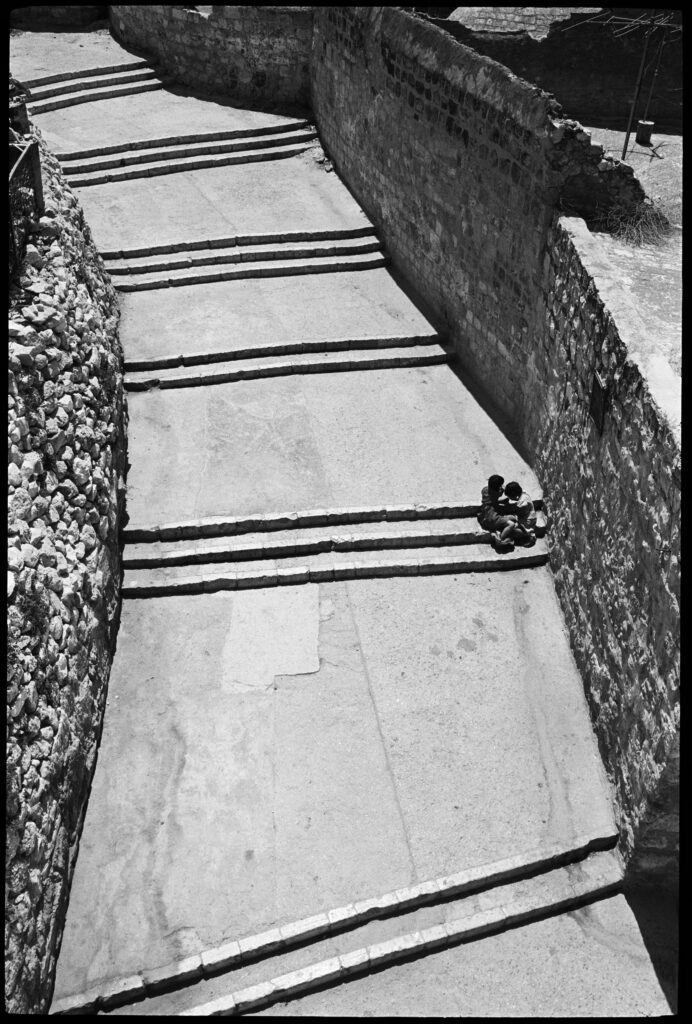
Bill Aron: I think the most important one is what’s referred to as The Tallit Steps. There is a ramparts that go around the Old City of Jerusalem. I would often walk around them because it was nice to just look at Jerusalem from that angle, from above. And I was noticing that there were shadows falling across the stairs. And it kind of seemed to me that the shadows and the bright sun were making geometrical objects.
And I just felt that connection in that moment, but I didn’t think much about the meaning of the—I didn’t call it The Tallit Steps, I just called it Shadows. And Richie Segal, a good friend who died recently, he was going through my proof sheets and he said, “This looks like a tallit.” And he was the first person to notice that. And I looked at it and said, “Oh, I guess it does.” And from then on, it became known as “The Tallit Steps.”
Ruth Ellenson: Is that an experience you have often? Because it’s something that happens to me as a writer, which I write something and someone reads it, and there is a meaning they find in it, which surprises and delights me—sometimes it’s not so delightful. (laughs) But something you didn’t necessarily see, but someone else allows you—a viewer allows you to see it more clearly or in a different way. Is that an experience you have often with your photographs?
Bill Aron: I wouldn’t say often, but it is an experience that I do have, and I love it. I love when people see something in my work that I had not originally seen or intended, because that gives—as I’m sure is true with your writing, too, Ruthie—it gives another dimension to what I have done. And I just love that feeling. It’s really nice.
Ruth Ellenson: It’s amazing.
There’s one you have of a young girl who’s probably ten or eleven years old, sort of crouched behind a tree, praying at what I imagine is the Western Wall, and she looks totally surprised and kind of gives you a bit of a furtive glance.
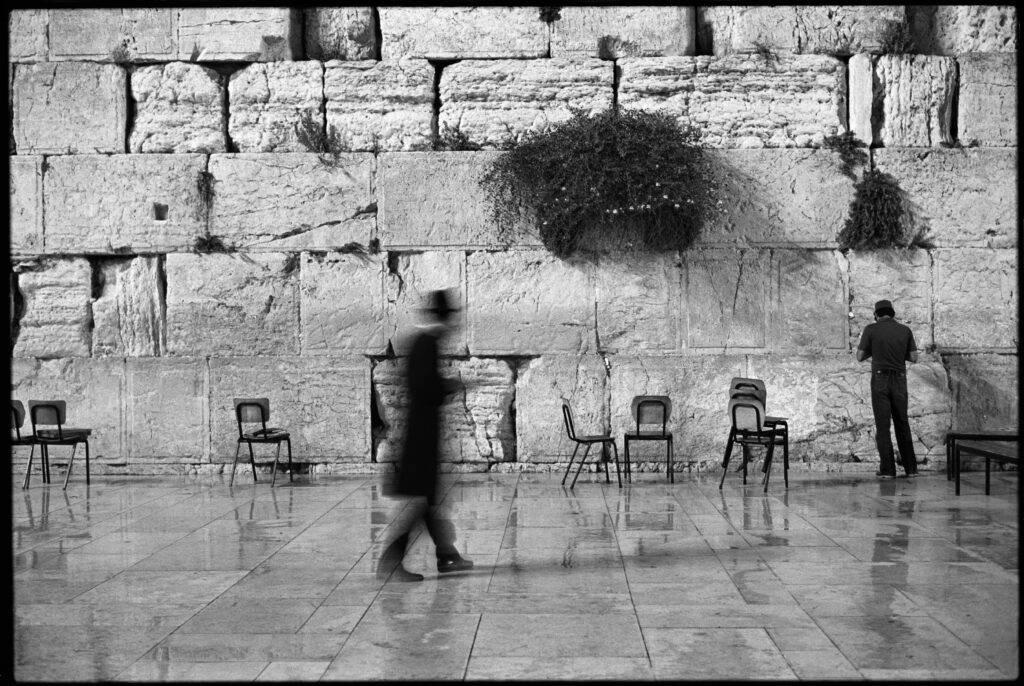
Bill Aron: I spent a lot of time that year at the Western Wall, and I was always photographing into the women’s section from the men’s section. And one day, I thought, Well, I wonder if I just walked in there, if I could, if I would be allowed. In 1980, it was a very different Israel, and nobody stopped me when I walked up to the Western Wall- into the women’s section of the wall. And I was walking around, and I saw this little girl off to the side, hiding partially behind a tree, standing on some rocks, davening off by herself. I noticed her, and I thought it was worthy of a photograph.
Host Ruth Ellenson: Contemporary images show a Western Wall that is crowded and teeming with people in prayer. You may have even noticed the gender segregated sections- but these elements are relatively recent.
Michael Brenner: So at the Kotel, as it’s called in Hebrew, the Western Wall or Wailing Wall, as some people call it, you know, it really changed dramatically in 1967. Between ‘48 or ‘49 and 1967, Jews were not able to even go there because it was Jordanian and Jews were not allowed to go there. We have pictures from the 19th century in the early 1900s where men and women were together. And we also have to remember, it was a very small alley, there were houses built right next to the Wailing Wall. And one of the first things the Israeli government did in 1967 after the Six-Day War was to tear down that small quarter that was there and the big plaza just started to come into existence. And I would say in the early years after that, the distinction wasn’t as strict as it became later. And that corresponds with the changing role of religion in Israeli society. The religious parties’ influence gained, but it also gained because of demographic changes. The ultra orthodox population has been growing much faster than the secular population. So, that is one of the reasons you see larger and larger crowds at the wall than you saw in the 1960s or 70s.
Ruth Ellenson: The Jerusalem photographs seem to have more of a timeless quality to them. Was that something you did on purpose, or was that just sort of what I’m seeing in the photographs, looking at them?
Bill Aron: Yeah, I think that’s a byproduct of the times. It was a young—in 1980, it was still young Israel, and it hadn’t, the population hadn’t exploded.
And as such, there was breathing room. And I think what makes it seem timeless is the solitary nature of many of those photographs, like this man smoking a cigarette, walking, and—you know, across the frame and at the Western Wall. You could never find just a single man walking across the plaza by himself. And in part, it also might be due to the contemplative nature of my working style that summer that I had the time to really sit and stare at a place and figure out the angle and what light was the most appropriate—morning, afternoon, evening—to photograph there.
Ruth Ellenson: So there really was a luxury of not only time, but an ability to capture a timelessness there that I think defines that body of work in a different way.
Bill Aron: Several years ago, my work came to a kind of reckoning. Because of the digital cameras, the world of professional photography was changing drastically and turned out permanently. The digital cameras were developing so quickly and getting better every year. Much of the commercial world of photography just fell by the wayside.
So, I began to wonder if there was still a place for me. So, I took a step back, and I didn’t want to just keep doing what I was doing. And it was about that time I came across multi-image panoramas. And so I thought that I would try it and see if I could develop my own style using this technique.
And I have to admit, with mixed success. I like some of the things—most of what I did, I did not like. So I thought I needed a subject, and instinctively, my mind turned to Israel.
Host Ruth Ellenson: Thirty years later, the Israel that Bill returned to photograph looked quite different from the country he had captured in 1980. Here’s more from Michael.
Michael Brenner: Between 1981 and 2010, Israel became a society with pretty high living standard compared, not just what it was before, but also compared to many, let’s say southern European countries. Israel was no longer the poor brother, the poor cousins which diaspora Jews had to pump in money. But Israel became a more or less self-sufficient economic society itself.
Host Ruth Ellenson: Bill worked meticulously to capture an evolving nation, creating large Panoramic images, some composed of 10 or more individual photographs stitched together.
Bill Aron: The first image I’ll talk about is—it’s called Outside The Damascus Gate.
Michael Brenner: The Damascus gate is kind of one of the centers of the eastern part of Jerusalem, of the Arab part of Jerusalem. And most of the people you would see there are Arab, but there are also Jews, especially Orthodox Jews, because Mea Shearim, the one of the biggest and maybe best known ultra-orthodox quarters of Jerusalem is just outside the walls and not far from the Damascus gate.
The Damascus gate has also been seen of some violence, sometimes it’s one of the busiest centers in, around the old town of Jerusalem. Besides Arabs and Jews, you also see tourists there. And I think that in a way reflects Jerusalem, but we often think only of conflict and violence, but we forget that Jerusalem is an incredibly diverse city. With all the problems that exist. People live together, people of different nationality, and people of different religions, and I don’t think that there are many places like that anywhere else in the Middle East or maybe even in the world.
Bill Aron: It’s just a big crowd of people with everybody, tourists, Jews, secular, religious, Muslims. I think there’s a Greek Orthodox priest in the scene. It’s just—everything came together.
I photographed from a tripod, and I put gaffer’s tape, little pieces of gaffer’s tape on the ground under the legs of the tripod so that I could come back several days in a row and photograph the scene in front of the gate—and always at the same time, so that I’d get the shadows correct. And I basically put it together so that all these different groups were represented. And for me, that’s Jerusalem. It’s time and the cultures—time in the ways that we were talking about it before, and the cultures that are represented there, where they overlap and they intersect. And it’s just the choreography of daily life. Everyone is navigating their own sacred or secular paths, and they’re all in the same space. And that to me signifies Jerusalem.
Ruth Ellenson: I love the idea of coming back to the same spot in the same place to capture the rhythm of life in a city.
Bill Aron: I was very glad nobody removed the gaffer’s tape. (laughs)
To me, in Jerusalem, we see all these new things, technology. But it could be just the old returning in another form.
Ruth Ellenson: That idea certainly speaks to the notion of timelessness and the ancient nature of Jerusalem and its modern iteration, and all of the Jerusalems it has been over the years. It’s a unique place in the world in that regard.
Audio: DSLR camera shutter
Host Ruth Ellenson: From the American Jewish Historical Society, I’m Ruth Andrew Ellenson. This episode was written by Rebeca Miller and produced by Sarah Hopley. Our executive producer is Gemma R. Birnbaum. Recording, sound design, and mixing were done at Sound Lounge and Studio Awesome.
For episode transcripts, exhibition information, additional resources, and links to a selection of Bill’s photographs that inspired this episode, please visit ajhs.org/bill. If you enjoyed this episode, please rate and review us, which helps others discover our series.