Megan Scauri, Senior Librarian, AJHS: The World in Front of Me is presented by Jay and Gretchen Stein, with generous support from the Knapp Family Foundation, the Philip and Muriel Berman Foundation in Honor of Alan Bloch, Scott and Dianne Einhorn, The Karetsky Family, and Michael and Corrie Koss.
In NYC? Visit the companion exhibition on view at the Center for Jewish History, now through May 2026.
Bill Aron: I’ve often thought that photography is so much more than when you press the shutter. I mean, clearly, it’s important the instant that you press the shutter. But I thought it represents how I feel, mostly how I feel, about what’s going on. But it also represents a history. I was always interested in people’s stories. And everybody’s story is worth hearing and understanding.
Host Ruth Ellenson: That’s Bill Aron, prolific photographer of Jewish life. I’m your host, writer Ruth Andrew Ellenson. I was fortunate to grow up being photographed by Bill, and welcomed the opportunity as an adult and a journalist to explore the legacy of his work, and the context in which it was created. Over the course of our series, we’ll travel with Bill across five decades, and hear his stories about documenting Jewish communities around the world.
From The American Jewish Historical Society, welcome to The World In Front of Me with Bill Aron. This is episode 2: New York.
In 1974, Bill left Los Angeles, and a career in sociology, and began to document Jewish life in the Lower East Side of New York City. Bill is part of a legacy of photographers who have documented disappearing communities and cultures, contributing invaluable primary sources that add to the historical record.
Ruth Ellenson: Hi, Bill.
Bill Aron: Hi, Ruthie.
Ruth Ellenson: Can you talk to us about how your background in sociology informs your work as a photographer?
Bill Aron: I was taking a portrait class with a great portrait photographer, Philippe Halsman. He would talk about interacting with the people before and during the portraits. And to me, that was revelatory. I—you know—my thinking up to then was, I know you’re not supposed to interfere with the photography process, but I liked talking to the people. So this was the first inkling that I could incorporate that into my photographic personality.
Deborah Dash Moore: So, street photography starts in the US with mostly left-wing photographers who are interested in the people.
Host Ruth Ellenson: That’s Dr. Deborah Dash Moore, Professor of History and Judaic Studies at the University of Michigan, and author of Walkers in the City: Jewish Street Photographers of Midcentury New York.
Deborah Dash Moore: And many of them would go back to the same streets over and over again and give out prints to people whom they took pictures of. The goal was to help working-class people come to see themselves in relationship to the world in which they lived that would hopefully mobilize them to want to make changes. So, it was a means of empowering people.
By the 1960s, street photography has shifted. It has become more expressive of the individual photographer, how he sees the world, rather than trying to let the people that he’s taking pictures of come to see their world.
Ruth Ellenson: I understand that you made a geographical and career change in 1974, moving from Los Angeles to New York.
Bill Aron: I found a placement at this wonderful organization started by a man who became a close friend, Misha Avramoff of Project Ezra, which was concerned with the Jewish elderly poor on the Lower East Side of New York, some of which very old people who had been immigrants themselves. And while I was there, I began photographing just because I wanted to and because I liked it. The fellowship was two years, and at the end of that, I had to figure out what I was gonna do. It’s not that easy. You don’t just sit there and think. I had to do something. It just wasn’t in my nature to sit and contemplate the universe. So, I began photographing more on the Lower East Side and on the Upper West Side, all over New York.
Deborah Dash Moore: The geography of New York City, when we talk about downtown, meaning the Lower East Side, and uptown, meaning the Upper West Side, that geography becomes labels for types of Jews, so downtown, immigrant, Yiddish-speaking, radical, but also Orthodox. Uptown, more assimilated, prosperous, often capitalist rather than working class, many of them born in the United States, not particularly radical and Jewishly engaged but not necessarily Orthodox.
Ruth Ellenson: I want you to describe what you looked like in the 1970s (Bill laughs) because everybody’s going to see you now, very distinguished with your gray hair and glasses and your excellent posture. But give a sense of who you were at this point in your life.
Bill Aron: I had a ponytail and a beard. And I never thought about it. I don’t know what my self-image was at that time, the visual self-image.
Ruth Ellenson: I also want to describe the proportions of this hair and beard and like, John Lennon little gold wire-rimmed glasses that I remember.
Bill Aron: Gold wire-rimmed glasses, yes.
Ruth Ellenson: I remember your hair being, like, to your elbows and your beard to your upper chest, (Bill laughs) to the point where, when you cut your hair and shaved off your beard when I was a child, when I saw you, I had no idea who you were. It was a very—I think of it as a very distinctive seventies hippie aesthetic.
Bill Aron: Right, right.
Ruth Ellenson: And the idea of you going down into the Lower East Side and immersing yourself amongst all these Orthodox Jews—it’s a hilarious juxtaposition. I’m sorry that there aren’t photographs of you photographing them.
Bill Aron: I’m amazed that nobody ever said anything or reacted adversely to my appearance. I know when I cut my hair and shaved my beard, the first time after that that I went into this minyan that Isa and I belonged to, everybody was looking at me and smiling and giggling. And I was thinking, uh-oh, what’s going on? I completely forgot that I had changed my appearance. And one of the members after services, stood up and said, “Well, I guess the sixties are finally over.”
Ruth Ellenson: (laughs) And this was in the 1980s, was that?
Bill Aron: It was about ‘79, ‘80. (laughs)
Deborah Dash Moore: So it’s really hard to imagine, but hippies were quite disliked. They were associated with anti-Vietnam War attitudes. They were seen as anti-establishment, which they were. And the fact that there would be a hippie-looking guy with long hair, and glasses taking photographs of old Jews would have aroused amusement. Among the people who also visited the Lower East Side was someone like Paul Cowan. He went as a journalist, to document poverty on the Lower East Side, which was not what Bill was after. Bill doesn’t take photos of poverty. He’s not doing an exposé in that regard. There’s a great deal of affection. And I think when you look at his photographs, you see his sense of connection with the people that he’s photographing, but he would have seemed completely like an outsider to these people.
Bill Aron: The Lower East Side at that point was old-style Judaism playing out in real time. And I just loved walking around the stores and photographing the storefronts and sometimes entering the stores and meeting the people and talking to them, and photographing them.
Deborah Dash Moore: The Lower East Side, historically, was the place where Jewish immigrants first came to New York. It wasn’t the only place, but it was the place where large numbers came. It was a poor neighborhood. And yet there were some sections of it that were—you know—relatively prosperous working class, but it was filled with tenements for the most part.
Now, Jews move through the Lower East Side. They’re always leaving the neighborhood, but in 1924, you have the end of immigration. And that means far fewer immigrants entered the country. Some still do in smaller numbers, but the effect of Jews moving out of the Lower East Side becomes much more apparent because there’s not all these people moving in. And certainly, by the time Bill would have gotten down there, I would say more or less, are remnants of the Lower East Side as a Jewish community.
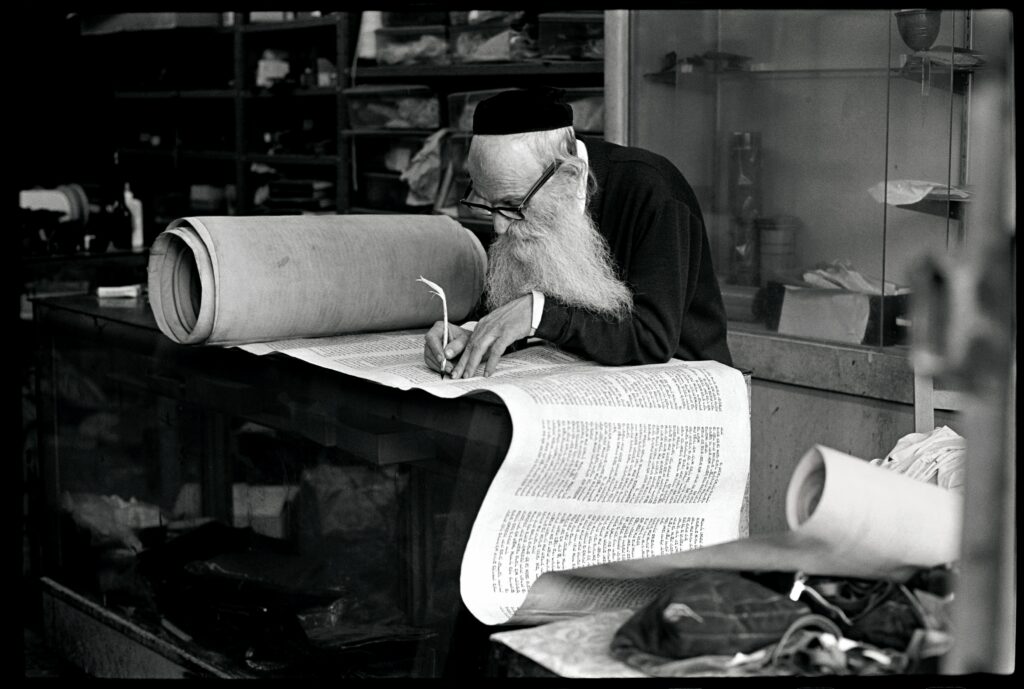
Bill Aron: There was a scribe named Rabbi Eisenbach, who had a longer name, but I knew him as Rabbi Eisenbach from Lower East Side. He had the traditional white beard. He wore a white shirt with a black sweater and black pants, and a black kippah. And he was just wonderful.
Ruth Ellenson: So there was a point in the Lower East Side where scribes, men who literally write Torah scrolls in Hebrew calligraphy, would have a storefront that you could go into their store and watch them write a Torah scroll?
Bill Aron: Right, the scribes in America at that time couldn’t compete with Israeli scribes to write new Torah scrolls economically. So their—most of their work was repairing existing ones. I would go into his storefront a number of times just because I liked him.
And one time, he explained to me that the recipe for ink is one that’s handed down for generations to him, from his father and then father, and so forth. And that each—every scribe, every legitimate scribe had their own recipe for ink that’s mixed from scratch.
Ruth Ellenson: Did you wander in with your camera and begin photographing him? And that’s how you had this conversation?
Bill Aron: I would say, Can I photograph you? He would say, “No.” He’d say, “This is God’s work. You can’t photograph me.” I say, “How about just your hands?” You would say “no.” So one day, part of my work was to take youth groups from the Upper East Side, the wealthier section of New York as a—on a tour of the Lower East Side. Everybody at Project Ezra would do this, all the people who work there. And I was—it was a hot day. His door was open. I was standing at the entrance. The youth group was outside, and Rabbi Eisenbach was working on his scribe inside. His door was open. And I just saw the photograph—I mean, it was one of the few instances of, I saw a scene and saw the photograph. And I raised my camera, and I clicked, just once, hugely loud click. And he looks at me over the top of his glasses. And then, when I’m telling this story, when I’m giving talks, I say, What do you think I did? And people say all sorts of things. You explain this, right? What I really did was run away. And a week or two later, I brought him an eight-by-ten photograph. And he looked at it, and he broke into this beautiful smile. And he said, “Very nice, thank you.” And his son, who was apprenticing with him at the time, said, “Take my photograph, too.” (laughs)
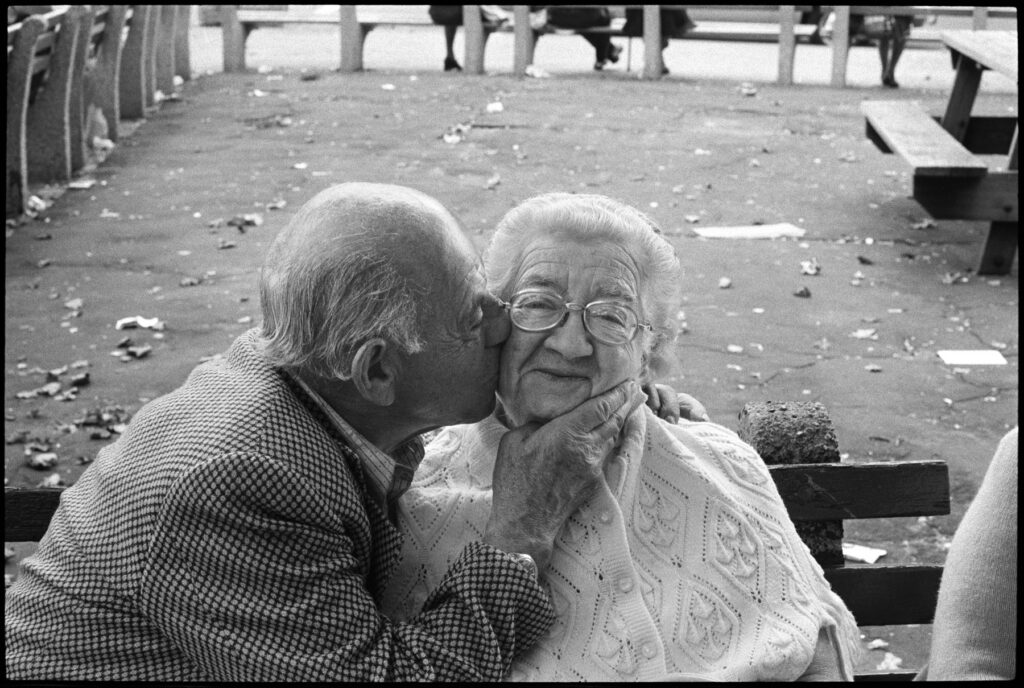
Deborah Dash Moore: He’s doing it out of his own interest as a young Jewish, in a sense, sociologist using the camera to come to understand and picture the community. So there’ll be pictures that he takes in a fish store or of an elderly couple sitting on the bench in Seward Park, or people walking along the street and—or sitting and reading the Forverts—the Yiddish newspaper. He is interested in recording this world that does seem to be disappearing. And it is disappearing in many ways. There are echoes of other Jewish worlds that have been destroyed. He’s conscious of the Holocaust that destroyed European Jewish culture, but this is not the same thing. Nobody’s coming and forcing people to leave. It’s a more generational process.
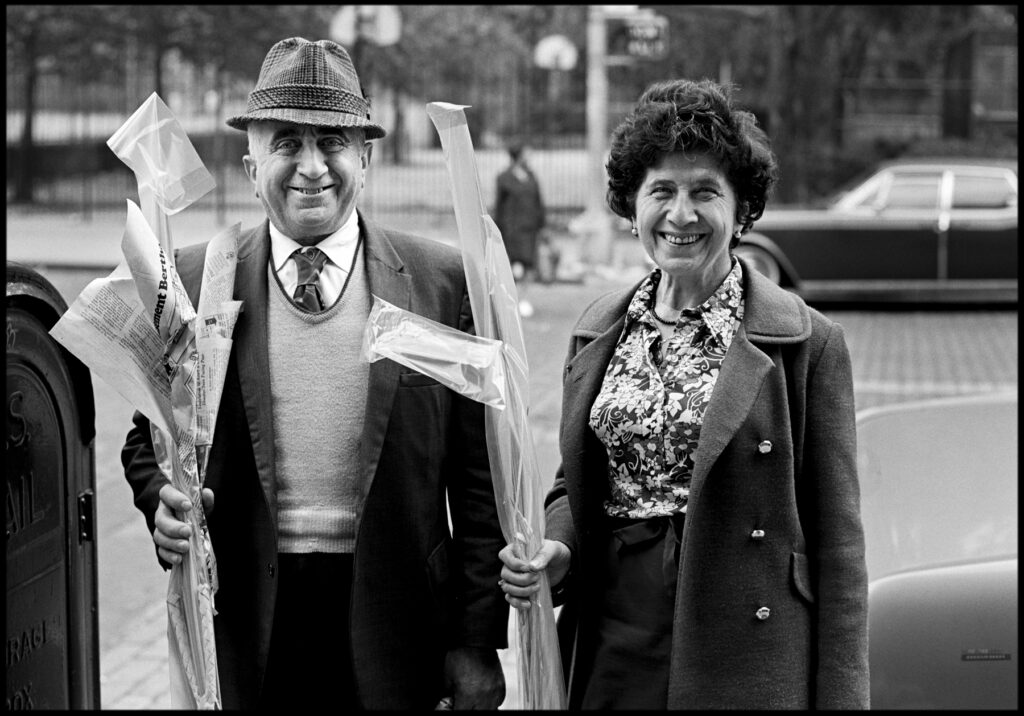
Bill Aron: There was a photograph I took on the Lower East Side of New York during Sukkot, when people were buying the lulav—lulav the miniature game. There’s a picture of a couple smiling, holding their new lulav in their right hand and the box with the etrog in their left hand, and just a bright smile looking at the camera. And Ze’ev Shenkin, a member of the havurah, looked at that picture, and he said, “Wow, American-Jewish Gothic” – after the American Gothic painting.
Ruth Ellenson: Havurah was a Jewish collective group that you joined in the 1970s in New York. How would you describe it?
Bill Aron: We became known as the eating club (laughs) for our lavish meals that we would have together. Friday night was a group meal, and then once a month, we would go outside the city on a retreat to celebrate the holiday and observe whatever rituals were associated with that.
Deborah Dash Moore: The New York Havurah is late sixties, early seventies. It’s made up of young Jewish men and women, quite a few of them married to each other. Some of them single, who reject institutional Judaism. They’re not interested in being synagogue members. They are, on the other hand, also very well-educated Jewishly. Many of them are continuing to pursue Jewish studies at Columbia, at JTS, etc., but they’ve rejected the institutional framework. Many of them are anti-Vietnam War. They are engaged in protests. They are also feminists. And they’re trying to create a different way to be Jewish, right? More egalitarian, informal, the beatnik kind of structures.
Bill Aron: But I have to say, the major distinction, for me, that I saw and that I had never seen anywhere else was the complete independence and the complete egalitarian practice of ritual among the males and females in the group. Women participated equally with the men in doing whatever part of the rituals that they were well-versed in. The only—anybody could take part. Anybody could lead a service. Anyone could give a drash. The only requirement was that you be knowledgeable in what you were doing.
Ruth Ellenson: So you would almost describe it as like a Jewish ritual petri dish? (Bill laughs) Like it was this open, experimental, 1970s space in which ritual was being reinvented.
And you’re allowed to photograph things, because I take it you would not be able to photograph traditional Jewish services, right? That would not be welcome in a more religious setting. Is that right?
Bill Aron: That’s correct. No synagogue would let me. Even reformed synagogues wouldn’t. I had some instances where the rabbi said, “No, no, that’s just not right.”
Deborah Dash Moore: It would have been thought to be intrusive to have a camera, a professional photographer who would be coming up close and taking pictures and getting in the way of the ritual practice. But the Havurah was informal, right? They didn’t all sit in their seats and face the bimah where the Torah might be read. There was a table.Kids moved in and out. I mean, it’s a very different feel to the enactment of ritual. And that informality was an important piece of the Havurah, things—the members didn’t like the stiffness and formal attributes of conservative or reformed, or even modern Orthodox services.
Ruth Ellenson: How did you begin photographing Jewish prayer services, Jewish rituals, and what was unique about the New York Havurah where you were able to explore that creative part of yourself?
Bill Aron: I really don’t remember the first time I picked up my camera during one of these times that photographing would normally have been prohibited.
They truly desired a creative expression of these ancient rituals that they were observing; not just modernizing it with changing of language, but to feel deeply a connection to the history.
Because of the havurah’s emphasis on the aesthetics of everything they were doing, I think they were open to my trying to capture their interpretations, capture what they were doing in as an artistic a way as I was able to.
Deborah Dash Moore: So, in some ways, you could think of the Havurah as an extended family.
I think that because Bill wasn’t an outsider, he was able to photograph a wide array of rituals that took place in the Havurah, as well as—without people feeling like the camera was intrusive. And that’s important because, sometimes, you can feel the camera really is intrusive and that it is pushing people to perform for the camera. But that was not the case with Bill’s photographs.
Ruth Ellenson: You know, I am a lifelong fan of your work and a subject of it. Although I do want this part on the record: Bill has taken pictures of me since I was two years old, and the only photograph that has been published in a book, as far as I understand, is one of me smiling from ear to ear at the moment of my younger brother’s circumcision. (Bill laughs)
Bill Aron: Can I then use this as a stepping off point and say what one of my earliest memories of you is?
Ruth Ellenson: Yes, please, go ahead.
Bill Aron: I met Ruthie during the Havurah years. Her family was also, along with my wife and myself, members of the New York Havurah. And we would, besides getting together for meals and going out of the city for holidays, we would meet often just to talk about things. Sometimes we’d just get together to gossip, I guess. But on this particular day, we were all sitting around in a circle. Most of us on the floor, of course. And Ruthie and her parents come in. And Ruthie runs to the middle of the circle, spreads her arms out and says, “I’m here!” But the point of that story is not Ruthie. The point of the story is that everyone in that circle held their arms out and wanted Ruthie to come to them.
Ruth Ellenson: You know, I aspire to that level of self-esteem as an adult. (laughs) It was a real gift to grow up in that type of Jewish creativeness, that expression.
Deborah Dash Moore: For a long time, most historians, people who study Jewish communities, have looked at photographs as illustrative. And they have not looked at photographs as the kind of document that a letter to someone might have or a newspaper report, or other—any other kinds of written materials. This is beginning to change where historians are starting to recognize that photographs can be read as informing how one understands the history of what was happening.
So it’s hard to know exactly, but I think that Bill’s photographs will come to serve as valuable historical resources.
Host Ruth Ellenson: From the American Jewish Historical Society, I’m Ruth Andrew Ellenson. This episode was written by Rebeca Miller and produced by Sarah Hopley. Our executive producer is Gemma R. Birnbaum. Recording, sound design, and mixing were done at Sound Lounge and Studio Awesome.
For episode transcripts, additional resources, and links to a selection of Bill’s photographs that inspired this episode, please visit ajhs.org/bill. If you enjoyed this episode, please rate and review us, which helps others discover our series.