Gentle Reader, it’s trivia time!
Today’s question: How many physical copies of each issue of American Jewish History are produced? The answer, 340, can be found inside the back cover of the latest edition, v. 108, #3. About half go to subscribers, c. 20% are distributed for free, and about 25% remain uncirculated. We recognize that scholars mostly access our articles digitally these days—thus this blog post—but if you still have space on your (what’s a…) bookshelf, the material versions of our scholarship continue to include rewarding chambers for further exploration.
Reader, you will also see that this issue presents history in retrograde, starting with the listing of Jewish names on the front, and tracking back to an article featuring figures named Sampson and Gershom in 1800. Perhaps in our next blog post we’ll open with a question about the editors’ motivations behind such an arrangement. For now, though we urge you to dig into this issue’s curiously local approach to American Jewish History.
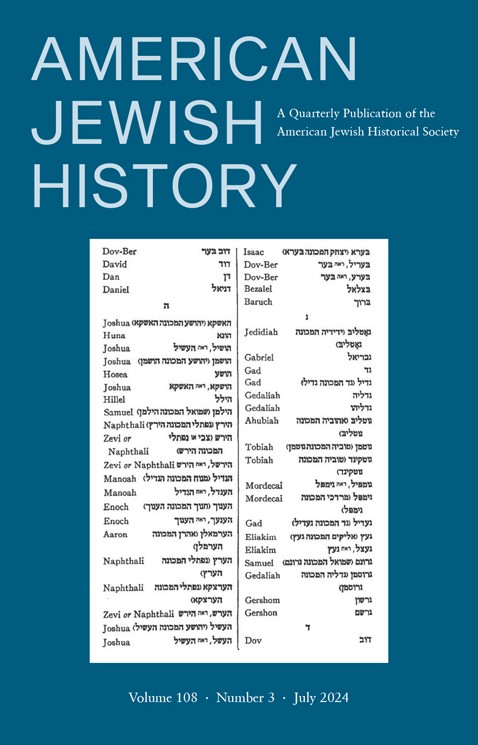
Our first essay by Sarah B. Benor and Alicia Chandler, illustrates how Jewish names are packed with meaning. Through a skillful combination of historical and sociological methods, including a contemporary survey (awesome for a history journal), Benor and Chandler provide a framework through which to categorize and understand the changing nature of Jewish names from 1950-2019. Among the essay’s many analytical gems you’ll is a discussion of how American Jews perceived the Jewishness of their names over successive generations—offering a new angle to the question of whether a Rose (grandma) is a Rose (daughter) is a Rose (granddaughter). The tables and figures, moreover, are rich with information and are not to be missed.
Next we move back in time and shift to the upper Midwest, where Jon Butler offers a new explores Minnesota’s efforts to combat anti-Jewish organizing during and after World War II. Moving beyond national or international-scale analyses, Butler reminds us how important local efforts were to our on-the-ground understanding of larger movements. His account of the Minnesota Jewish Council, for example, reveals an underlying strategy against antisemitism that began with Jewish-specific efforts in the late 1930s, but moved toward a more collaborative civil rights discourse by the early 1940s. Did other states do the same? We won’t know, Butler says, until tomorrow’s historians present more local case studies for comparison.
Finally, Michael Hoberman brings us back to Columbia University, dateline 1800, to relive the Hebrew commencement address delivered by Sampson Simson and written by hazzan Gershom Mendes Seixas. Offering a strikingly new take on a well-known text, Hoberman presents the oration as a history of American Judaism through a New York lens, at a time when New Yorkers were thinking about their own identity through the lens of the American republic. As historians experiencing this speech 225 years later while approaching the American semi-sesquicentennial, we see Hoberman’s account as an opportunity to look both forward and backward, through narratives rewritten and rewritten, while gaining a glimpse into the origins of our field. And bonus!: here’s a link to the original document, with Hoberman’s introduction: Sampson Simson’s Commencement Address – American Jewish Historical Society.
And then there are the jewel-like reviews—several short-form evaluations of recent literature that weave together our field’s latest research, with one larger review essay. Look for Joseph reviewed by Geraldine, Adriana and Laura reviewed by Sarah, Ronnie reviewed by Hugh, Jeffrey reviewed by Doug, Melissa reviewed by Mona, Adam reviewed by Joshua, and Diane reviewed by Jillian.
Writing from our various perches in Connecticut, Georgia, and Indiana/Ohio, we recognize the importance of local stories to the larger landscape of American Jewish history. This issue inspires us to stay focused and think big as we consider new ways to understand the many narratives of Jews and Judaism in America.
With warm wishes on these cooling days,
Marni, Jessica, and Judah.
View the digital version of American Jewish History, Vol 108, No. 3, July 2024.