In 1988, the Reverend Jesse Jackson emerged from a photoshoot with Rolling Stone on Fifth Avenue when an enthusiastic crowd gathered before him. Jewish journalist Jack Newfield described the scene, observing Black supporters “in ecstasy” over the civil rights veteran. Jackson, in his historic campaign for President of the United States, had just scored significant victories in the Democratic primaries. Newfield shared the excitement of the cheering crowd that had seen something incredible: “a Black man suddenly looking like he could be nominated for President.” In that moment, Newfield reflected, “I saw Jackson as the underdog warrior giving hope to people who didn’t expect much from politics.”
For as much as Newfield identified with the underdog, American Jewish impressions of the late Reverend Jackson were not so universally rosy. Between the 1980s and 1990s, Jackson’s political career exposed broader tensions between Black and Jewish Americans, culminating in public disputes but also compassion and reconciliation. Controversial statements made by and about Jackson convinced commentators that the “Black and Jewish alliance,” which had prospered during the midcentury Civil Rights Movement, had finally flatlined. Beyond acrimonious exchanges between Black and Jewish spectators, Jackson’s presidential runs prompted challenging conversations within the Jewish community itself.
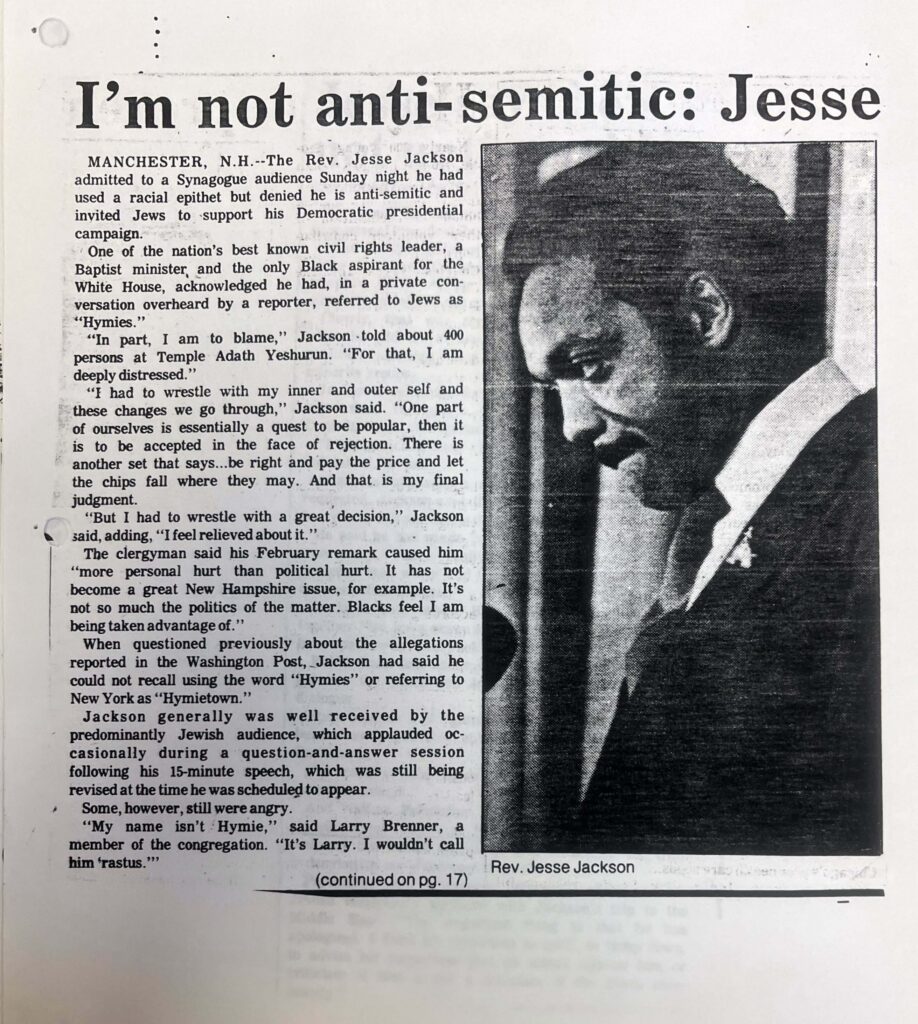
The trouble started in 1984, when Jackson followed in Shirley Chisholm’s footsteps and became the second Black candidate to launch a nationwide presidential campaign. In an off-the-record exchange with a reporter, he infamously referred to New York City as “Hymietown,” invoking derogatory language about Jews. Throughout the year, Jewish civic leaders like those in the Anti-Defamation League (ADL) excoriated Jackson as an unrepentant antisemite. Nathan Perlmutter, the ADL’s executive director, charged that Jackson had made multiple remarks about Jews that trafficked in harmful stereotypes. His association with Louis Farrakhan, the openly antisemitic leader of the Nation of Islam, caused further consternation. Jackson subsequently repudiated Farrakhan and clarified that he did not “believe in [Farrakhan’s] racism,” nor did he harbor any antisemitic views.
The controversies incited emotionally charged dialogues between Black and Jewish citizens. Many reflected on their intersecting pasts, lamenting the apparent strains to the “grand alliance” of prior decades. At one public forum, a Black veteran stood “and recalled how Black soldiers in World War II helped liberate European Jews from Nazi concentration camps.” He noted, “nobody talks about the contribution Blacks made to Jews,” whereas Jewish involvement in civil rights advocacy received abundant attention and praise. The resentment stemming from Jackson’s candidacy led some to entertain a “peaceful divorce” in which both groups could go their separate ways. Ethel Payne, dubbed the “First Lady of the Black Press,” objected to the ADL’s “constant watchdog” practices aimed at Black politicians. “I do not tolerate self-appointed censors, be they black or white, Jews or Gentiles,” she proclaimed.
Some Jewish extremists exploited the incident. Meir Kahane, leader of the militant Jewish Defense League (JDL), sustained a vigorous “Jews Against Jackson” campaign to bury the candidate with Jewish voters. The initiative started in 1983, before Jackson’s slur, in response to his recognition of the Palestine Liberation Organization. Jackson complained that the JDL had “hounded, pursued, and persecuted” his campaign team. Perlmutter disavowed their tactics and rhetoric, clarifying that Kahane’s radical followers did not represent the Jewish mainstream. Jackson took the opportunity to remind all those involved that rabble-rousers like Farrakhan and Kahane did not speak for Black or Jewish communities. “Just as you say to trust you,” he responded to his Jewish critics, “you must trust me.” The hurtful words of an extremist “should not be the litmus test for the Black-Jewish relationship,” he added.
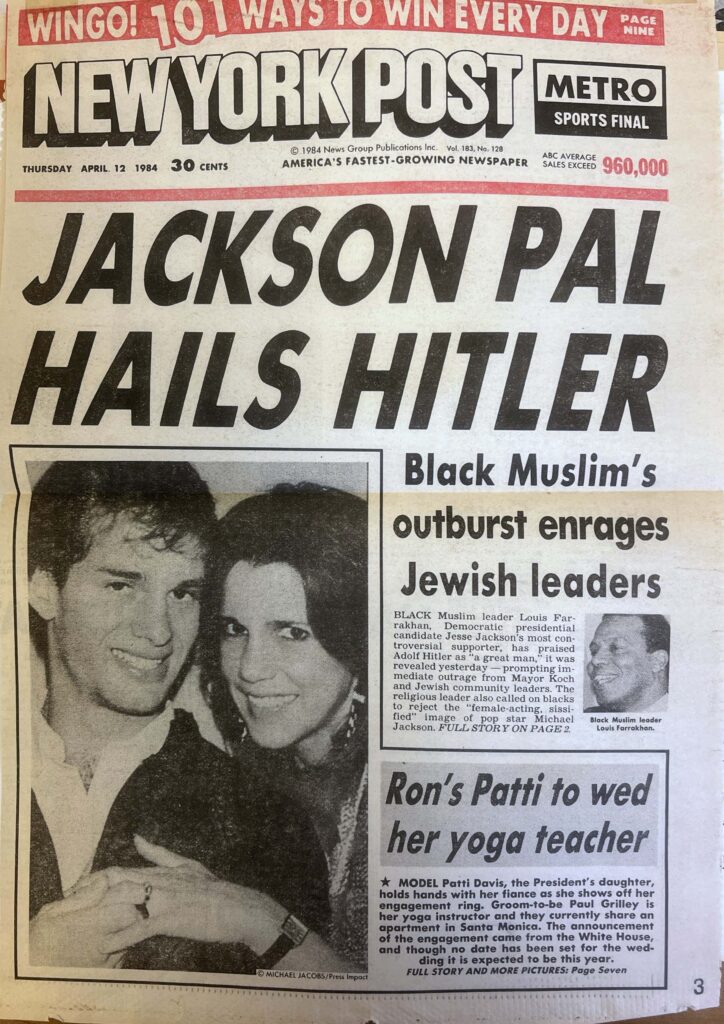
The scandals caused significant debate within Jewish circles. Perlmutter scoffed at the “young liberal Jews” who had formed “Jews for Jackson committees.” Those in agreement with him emphasized maintaining “the dignity of the Jews,” and asked, “just how much are we asked to accept without reacting as normal human beings?” Those further to the left regretted that the Jewish agencies were pressuring Democratic politicians to renounce Jackson. Political theorist Philip Green blasted Perlmutter for having “the chutzpah to tell us what Jackson’s positions and statements mean to the Jews.” Green opined that it was not up to any individual to determine “what is good for the Jews and bad for the Jews.”
Black and Jewish liberals each commented on the larger consequences of Jackson’s controversies. Jack Newfield implored Jews, who had traditionally voted for left-wing candidates, to reject political weaponization of the issue. He resented that George Bush “had nothing to say” in the face of racist comments by fellow Republicans Peter Grace and Earl Butz. Yet Bush “appeared before a Jewish audience and attacked Jesse Jackson” while suggesting that Democrats “were insensitive to the horrors of antisemitism.” One of Jackson’s Black allies, Calvin Butts, held deeper concerns. If Black and Jewish citizens were “tearing at each other’s throats,” he imagined it would “bring down the wrath of a right-wing America on both of us.” He stressed that the worst enemies of Black and Jewish communities were not reasonable people who had made mistakes, but “the Klan, the Nazis, and the White Citizens Councils” who thrived on division.
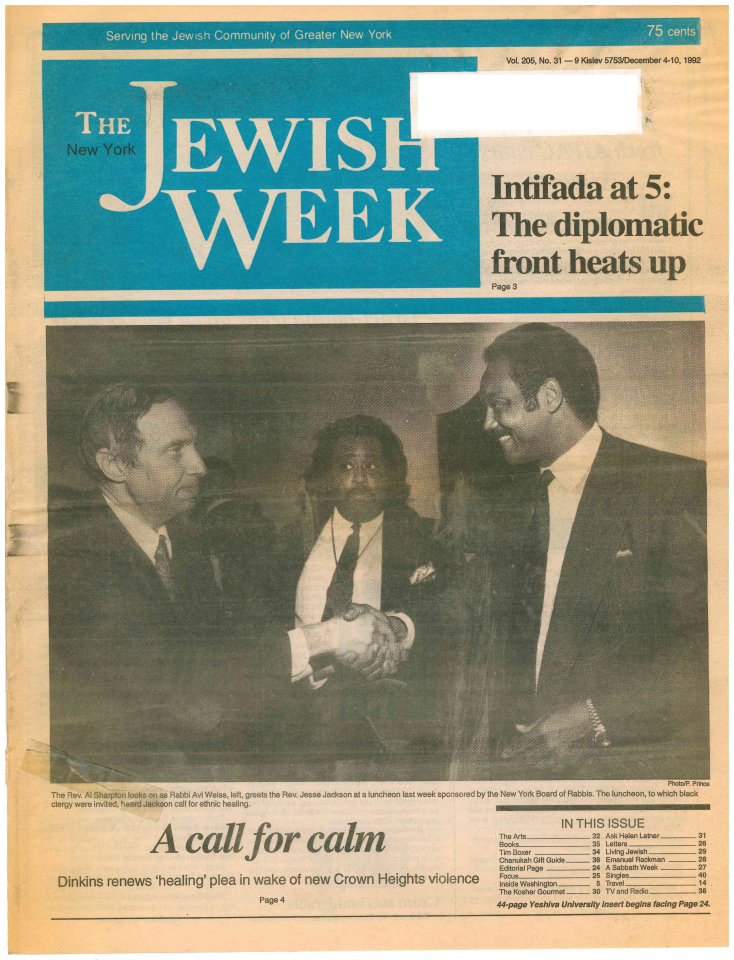
After Jackson lost the 1984 nomination, his performance improved in the 1988 Democratic primary where he finished in second place to Michael Dukakis. The uproar over his antisemitic statements followed him through both campaign seasons and in 1991, when the Crown Heights debacle sparked new antagonism between Black and Jewish residents of Brooklyn. Mayor David Dinkins, New York City’s first Black mayor, upset the local Jewish community with his perceived inaction against antisemitic crimes during the riot. Jackson came to the mayor’s defense, reawakening the earlier controversies but opening the door for reconciliation when it was most crucial. In his own defense, Jackson maintained, “I made a regrettable error, and expressed my regret to the whole world,” urging forgiveness for himself and Dinkins.
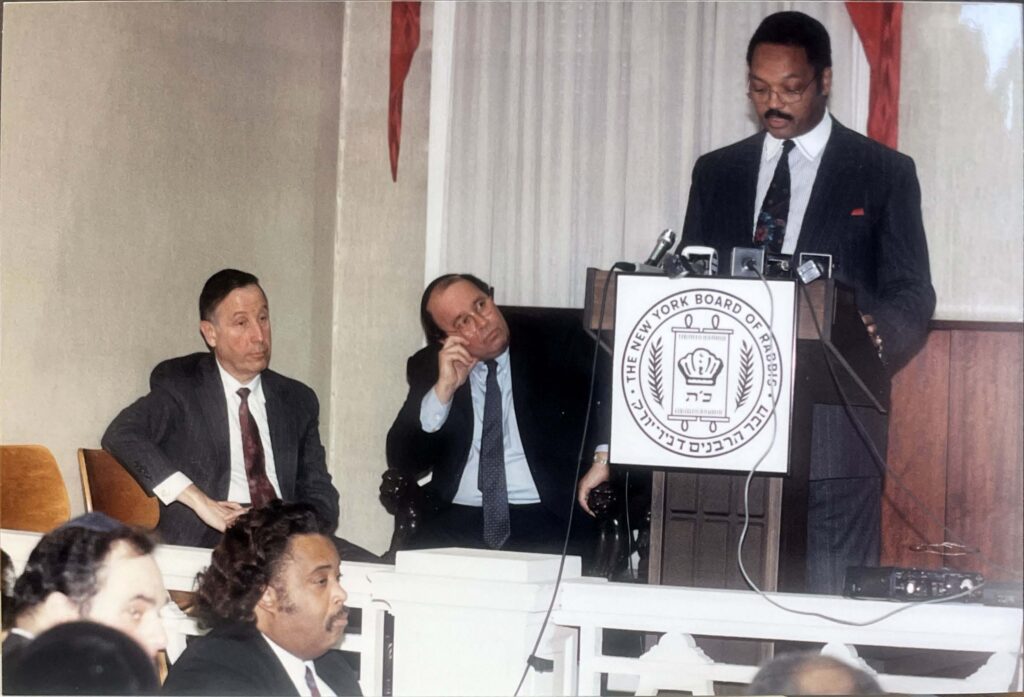
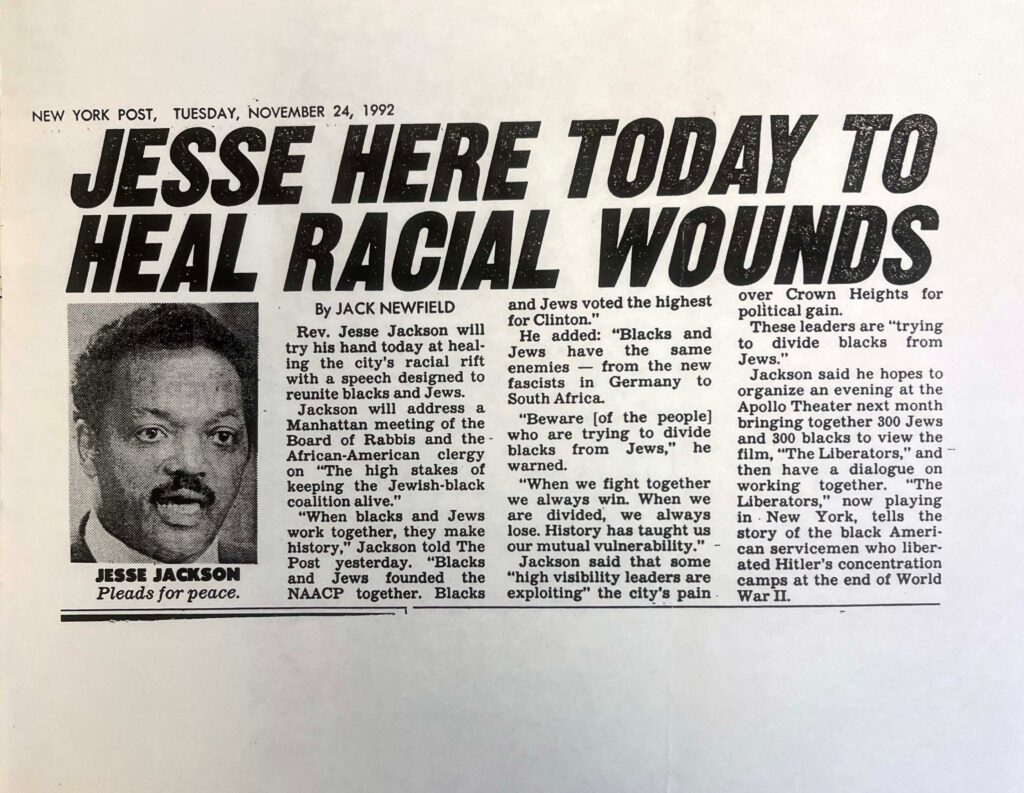
Many Black and Jewish leaders understood that if not handled appropriately, the hostilities which emerged out of Crown Heights could have descended into further devastation. Jackson was among those who worked tirelessly to repair the hurt caused by the episode. Speaking to Black and Jewish audiences, he insisted that without their collaboration, “we could not have ended apartheid in this country.” The New York Board of Rabbis began hosting annual Thanksgiving luncheons with Black leaders and clergy. Speaking at one such gathering, Jackson stated that political figures like David Duke were far more dangerous than Mayor Dinkins. Jewish attendees concurred but acknowledged that he might have been “preaching to the choir.” Jackson replied wisely, “it’s appropriate to preach to the choir when there’s conflict in the choir.” Despite long periods of tension, these steps toward healing reflected the strength and continuity of Black and Jewish advocacy for peace and partnership. On February 17, 2026, when Jesse Jackson passed away at the age of 84, he left behind a legacy devoted to racial justice that included unifying Black and Jewish Americans.
View the New York Board of Rabbis Records
View the Nathan Perlmutter Papers