Megan Scauri, Senior Librarian, AJHS The World in Front of Me is presented by Jay and Gretchen Stein, with generous support from the Knapp Family Foundation, the Philip and Muriel Berman Foundation in Honor of Alan Bloch, Scott and Dianne Einhorn, The Karetsky Family, and Michael Koss.
In NYC? Visit the companion exhibition on view at the Center for Jewish History, now through May 2026.
Bill Aron: Cuba, sì, Yankee, no.
Ruth Ellenson: What?
Bill Aron: You ever heard that? Cuba, sì, Yankee, no? It was the rallying cry of the pro-Cuba movement during the—or was I in college? Fair Play for Cuba was the name of the movement. I wasn’t that politically aware, but I used to go to these meetings because it looked to me like all the cool guys on campus were part of this. But in my naiveté.
Host Ruth Ellenson: That’s Bill Aron, prolific photographer of Jewish life. I’m your host, writer Ruth Andrew Ellenson. I was fortunate to grow up being photographed by Bill, and welcomed the opportunity as an adult and a journalist to explore the legacy of his work, and the context in which it was created. Over the course of our series, we’ll travel with Bill across five decades, and hear his stories about documenting Jewish communities around the world.
From The American Jewish Historical Society, welcome to The World In Front of Me with Bill Aron. This is episode 7: Cuba.
Bill Aron: During the Carter administration, there was a brief thaw between the US and Cuba. And a mutual acquaintance knew the—the Cuban ambassador of the United Nations. And they put together a group of Jews to go visit the Jewish community in, in Cuba.
Ruth Ellenson: What did you know about the Jewish community in Cuba before you were approached to go on this trip?
Bill Aron: Nothing—really, literally. It was—for me, it was an opportunity to photograph. I knew that Cuba had become a communist country. And I guess under the influence of those meetings, I used to go to—that it seemed like it was the fault of the United States because we—when Castro took over, we withheld our support, and Russia offered the support.
Ruth Ellenson: So we have no one to blame but ourselves.
Bill Aron: That’s—I guess that’s what I felt at the time.
Gemma Birnbaum: So in February, 1962, the United States, which at that time was under President John F. Kennedy, issued an embargo on trade between the US and Cuba.
Host Ruth Ellenson: That’s Gemma R. Birnbaum, executive director of the American Jewish Historical Society.
Gemma Birnbaum: And so this is somewhat on the heels of the failed Bay of Pigs invasion in 1961, which was essentially an attempt, funded by the United States, to oust Castro.They were members of an organization called the Cuban Democratic Revolutionary Front. It certainly did nothing to help diplomatic relations between the US and Cuba when this failed, invasion came to light, it was international news, pretty big scandal.
In September, later that year, in 1962, Kennedy announces an even stronger embargo, plus economic sanctions, which is all to say there is no love loss between the US and Cuba at this point. You can cut to the Carter administration and the US is under kind of tepid policy, um, of non-aggression with the Soviet Union. You know, we’re in the era of Detente. The Soviet Union is also a country that Castro and Cuba have very close ties to diplomatically. So Castro does follow the kind of Soviet line here, tows this party line, softens his approach and his rhetoric against the United States. And this does help to a degree open up channels for trade and immigration, but it’s still very limited.
So even with this kind of easing, and it’s likely why somebody like Bill was able to actually visit, this is still both a very restrictive nation. The US is still actively discouraging Americans from going there, Any American who wants to visit Cuba has to first go through another country, stop there, and then go on to Cuba. That restriction’s not really starting to lift until 2011 and it doesn’t really fully go away until 2016 at the end of the Obama era. So you’re talking about decades and decades of limitations.
And so it’s not just that people can’t come into Cuba, it’s also really difficult to, to leave Cuba. But at this point, 95% of the Jewish population has already left. So you’re talking about a very small number of people, most of whom don’t actually want to leave and want to stay there. Like they don’t wanna be driven from their home of however many years. And so it becomes a really, um, sensitive situation, both in the country of Cuba at large and in these smaller sort of ethnic enclaves, Jewish and non-Jewish.
Ruth Ellenson: So, you get approached to be with this delegation that goes to Cuba, and you are there specifically as the photographer to document the Jewish community? That’s what you’re asked to do?
Bill Aron: That was my self-imposed mission. That’s what I wanted to do. It was a difficult trip for me in that I saw lots of things that contradicted the idea of “Fair Play for Cuba.” And it really made me wonder what Cuban society would be like if Batista hadn’t been overthrown in favor of Castro’s regime.
Gemma Birnbaum: So, prior to the revolution, Cuba was kind of like a, a haven for Jewish people, particularly those who were prevented from entering the United States, after some very aggressive restrictions on immigration in the form of legislation like the Johnson Reed Act of 1924, and others. So this allows the Jewish population in Cuba to reach its peak of 25,000. They were able to practice relatively freely. There was a place for every kind of Jew in this community.
After the revolution, there is growing fear, not just over what is happening, but over what might happen. Like nobody actually knows yet. So initially many of the Jews in Cuba who are either first, second, or third generation, and they’ve fled hostile nations and, they entered Cuba under their refugee status. Initially there is Jewish support for the revolution, largely. Because many people, not just Jews, just really wanted to get rid of Batista, who ran Cuba as a dictatorship. But especially for those Jews who came from the USSR where they had endured all sorts of restrictions, both spiritually and economically, and living in fear of this Gulag system, Castro and the Communist Party was also initially, pretty much immediately perceived as potentially threatening. Castro’s close ties to the Soviet Union were pretty well known. He’s not hiding it. He’s, he’s touting it, as a sort of communist bonafide. He follows whatever the Soviet Union does in terms of classifying their government as socialist.
Ruth Ellenson: How did you navigate the governmental restrictions that Americans have in Cuba?
Bill Aron: Well, there were two things. There was a friend from Israel, a Haim Gold Grabber, who also photographed in Cuba. The problem that we had. He was Israeli. The problem in Cuba, Castro was anti-Israel. And most people thought he was anti-Israel because of pressure from the Soviet Union. So, he and I would get up about five-thirty or six o’clock in the morning, and we’d wander the streets, just seeing what we could see.
Ruth Ellenson: In Havana.
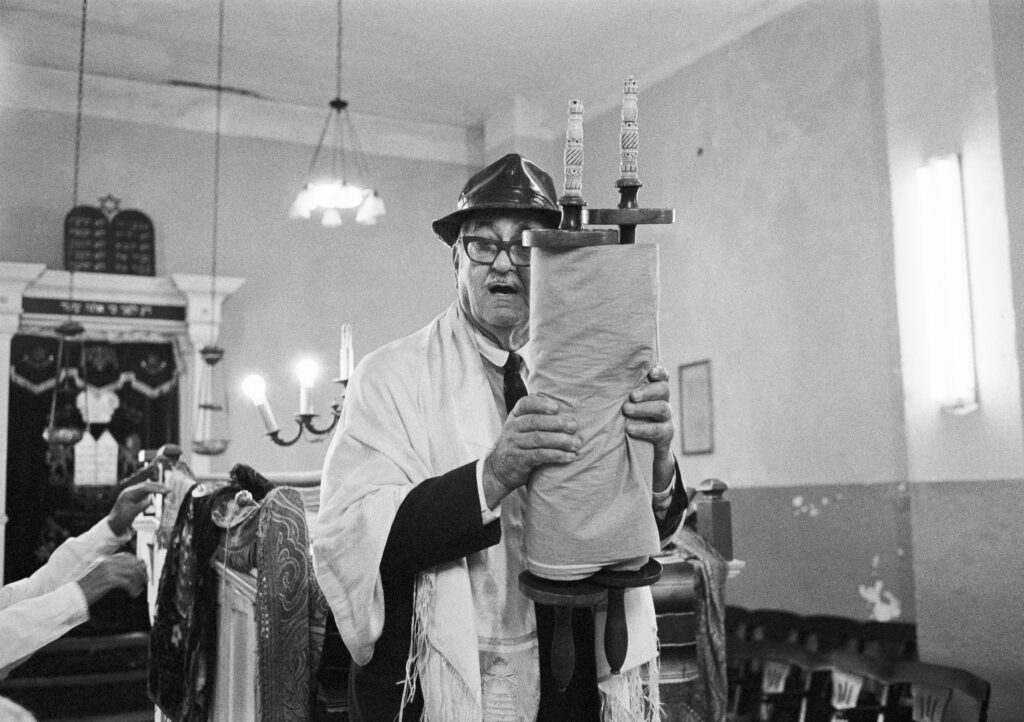
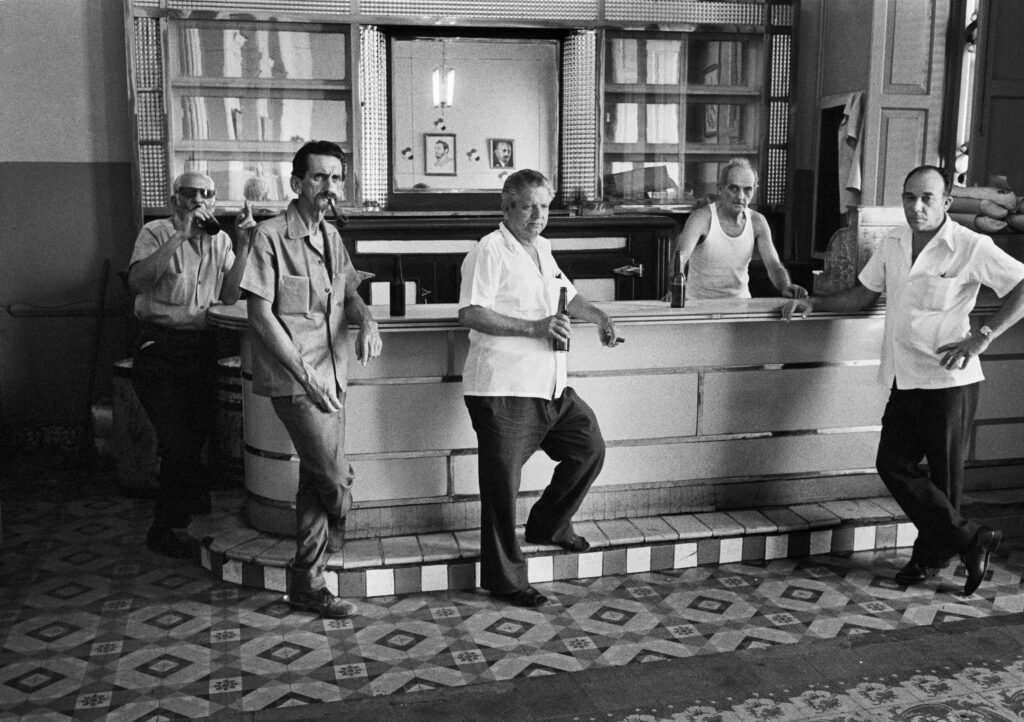
Bill Aron: In Havana. And it was really interesting there really weren’t coffee shops; the bars served coffee. And early morning, when it was still dark, Cuban citizens—they would gather at these places to have whatever they were drinking, and then trucks would come by about seven or so. And everybody would get in; they would go off to whatever work they were doing. And by seven-thirty, we would then go to one of the four synagogues there were. Because there was no overt antisemitism, the Cuban government maintained four synagogues.
But they were allowed to exist, and they got a meager subsidy from the government to stay open, to keep their doors open for people. Anyway, so we would go to services, and we were honored with aliyot, and whatever tea and bread they had afterwards, they shared with us. And it was really quite lovely.
Gemma Birnbaum: I think in order to understand what Jewish life in Cuba was like, you have to understand religious life in Cuba more generally, which is, it is designated an atheistic country. Which means no religion is able to be practiced as freely as they would like it to be. So it’s not just Jews, it’s also Catholics, it’s, it’s anybody, um, who is living what they sort of call the “spiritual life.”
Bill Aron: One particular morning, we’re leaving the place where people were congregating or waiting for the trucks. And this guy runs over and said, “Stop! You’ve got to come with me.” Not so fluent English, but it turned out there are—what were they called?—neighborhood officers who were in charge of seeking out espionage. Haim, of course, at this point, starts freaking out because he’s Israeli, and he has an Israeli passport. And he told me not to say that we had our passports with us. So, we started telling this guy that we’re American tourists; we’re just walking around and admiring Cuban society. We’re tourists, so we take pictures because we had cameras. And after about an hour, they let us go. We managed to convince him that we were harmless tourists.
Gemma Birnbaum: After the revolution, many of the Jews start to withdraw from religious life actively. So even if they’re not asked to yet. That meant they were giving up rights and rituals. They stopped celebrating a lot of the holidays, and observing others. They stop attending synagogue, and so a lot of the membership start to decline. A lot of the synagogues, even if they’re not forced to close, they can’t afford to stay open because they don’t have enough of a congregation. It was not easy to get kosher food. Uh, that’s especially true after the embargoes get stronger, uh, because you can’t import anything. One of the sort of biggest things that people eat in Cuba is like pork. So for both Jews and other Cubans of various faiths, it becomes increasingly difficult to practice your religion freely, and that doesn’t really abate for quite a long time. So by the time Bill has taken these photographs, I would consider it, even in that sort of calm era, a bit of an act of rebellion to be able to even do any of the things that he sees them engaging with.
Bill Aron: It was that if you practiced religion and went to religious services, you were not allowed to belong to the Communist Party. And if you could not join the Communist Party, you could not be promoted at work. You could still work. I mean, it wasn’t as harsh as what Russia did to the refuseniks. There were also voluntary work brigades, that worked in the countryside. But if you were going to religious services, you couldn’t go. What remained as part of religious observance were old people. And not just Jewish, Protestant, and Catholic.
One time, we were wandering around, and we saw this beautiful church. And so, we went in, and we sat at the back. It was hot outside; we were tired. We were curious. So we just sat there, and after the services, the priest came running up to us and started saying, “run,” just “run on” in Spanish, which he later said he thought we were young Cubans coming to church.
Host Ruth Ellenson: Bill doesn’t speak Spanish. But I suppose anyone who spends enough time in Los Angeles – home to a significant Spanish-speaking population- is bound to pick up a few words and phrases.
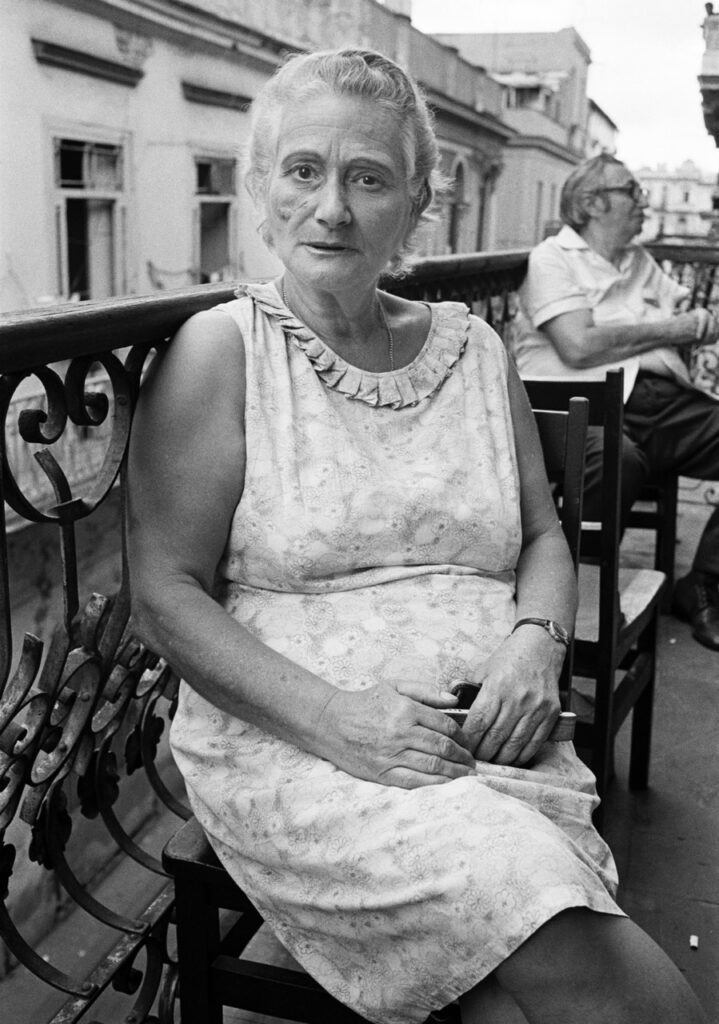
Bill Aron: The group also had state-sponsored translators. So, that was a problem because you don’t know what the translators were really saying, and whether what they were telling us was just the party line or they were really translating. So, we went into Shevet Achim, which was an Orthodox Sephardic synagogue. And we’re upstairs, talking to the people in the synagogue. And the members themselves didn’t trust the translator. So they were going Parlez-vous français? English? Esperanto, one person said. And I—just as a joke, I threw out the phrase in Turkish, “Do you speak Turkish?” And this one woman said—drops her mouth open, her eyes wide, and she starts in Turkish, “Do I speak Turkish? Of course, I speak Turkish! I’m from Turkey, and so is everybody here.” (laughs) And, Celia, and we became great friends. And in any other Jewish community in the world, I think the level of friendship would have deserved an invitation to dinner, but not in Cuba, because I found out—Celia confided that she couldn’t invite us to her home because they had nothing to offer us. And the home was a partitioned apartment from a much larger apartment that had been used by one family before the revolution.
Host Ruth Ellenson: You may be wondering, “why, or how, does Bill know Turkish?” Well, as it happens, after college, he had a stint in the Peace Corps.
Bill Aron: I was in the Peace Corps, a volunteer in Turkey. The first year in a—in central Turkey, kind of a largish town but not a city. In the second year, a little town called Arhavi on the Black Sea, right next to the Russian border…
Ruth Ellenson: And it’s also amazing that, this experience you had after college of joining the Peace Corps, going to Turkey because you basically didn’t know what you were going to do in your life, came back at such a critical moment in your photographic career to really allow you to bridge a divide with your subjects that otherwise would have been controlled through various political entities. It allowed you to make a human connection.
Bill Aron: Yes. The thought has occurred to me that my sojourn in Turkey for four years was all in preparation for this meeting with Celia.
Gemma Birnbaum: To understand the Cuban Jewish population in the late 1970s and the early eighties, you have to go back a bit, further, because by the time you’re into the Carter administration, the vast majority of Cuban Jews have already left. So we’re talking about a community that before the Cuban Revolution, and the rise of Fidel Castro in 1959 was around 25,000 people strong. Um, ethnically it was very diverse, so you had Jews from Greece, Syria, Egypt, the USSR was a big one, Turkey, Spain. Um, and so a pattern is kind of emerging here, of Jews coming from places that historically they were driven out of.
By the time Bill travels to Cuba, the Jewish population is really small. Was estimated to be maybe as little as 1500 individuals, not families, but individuals. Um, so you’re talking about even fewer families. Ethnically, you had a combination of Sephardic Jews whose descendants, or sometimes even they themselves, had fled Turkey in the early 20th century, which was around the collapse of the Ottoman Empire, which also coincided with a rise in antisemitism there. You had Ashkenazi Jews who had fled Europe during the era of Nazi rule and persecution during World War II. They had been accepted into Cuba when the United States and other nations had turned refugees away. Most left Cuba after the 1959 revolution, but a fair number did stay, in what had become their home for four decades. And so a lot of the people that are living there, they’re third, second, fourth generation, like they’ve been there a really long time. Their families have been there a long time.
Ruth Ellenson: What was a moment from your travels in Cuba where you encountered something beautiful or joyful?
Bill Aron: On Lag BaOmer, we went to the synagogue. And we were all—there was a regular service, and then afterwards, everybody was sort of talking and singing songs. And all of a sudden, spontaneously, everyone stood up and began singing Hatikvah. And I—and among the Americans, there wasn’t—including myself—wasn’t a dry eye in the room. I can actually shiver just thinking about it. It was such an electrical moment that—unlike any I’ve ever experienced.
Ruth Ellenson: Wow.
Bill Aron: It was the peak of the trip.
Ruth Ellenson: It’s amazing.
Audio: Late 1970’s camera shutter.
Host Ruth Ellenson: From the American Jewish Historical Society, I’m Ruth Andrew Ellenson. This episode was written by Rebeca Miller and produced by Sarah Hopley. Our executive producer is Gemma R. Birnbaum. Recording, sound design, and mixing were done at Sound Lounge and Studio Awesome.
For episode transcripts, exhibition information, additional resources, and links to a selection of Bill’s photographs that inspired this episode, please visit ajhs.org/bill. If you enjoyed this episode, please rate and review us, which helps others discover our series.